Key Takeaways
- Digital PR link building earns editorial backlinks from news sites and publications — the kind of links that both Google and AI search engines trust most.
- The average digital PR campaign earns links from 42 unique domains at an average DR of 61, with 20%+ coming from DR 70-79 news sites (Digitaloft / Reboot Online).
- Brand mentions are 3x more predictive of AI visibility than backlinks — a 0.664 vs. 0.218 correlation across 75,000 brands (Ahrefs, 2025).
- Only about 17% of AI Overview citations come from pages ranking in the organic top 10 — ranking no longer guarantees AI visibility (BrightEdge, 2026). Digital PR closes that gap.
- Earned media accounts for 84% of all AI citations, while paid and advertorial content is just 0.3% — AI overwhelmingly trusts editorial coverage (Muck Rack, 2026).
Digital PR link building has replaced guest posting, press releases, and manual outreach as the dominant way to earn backlinks. Not because it's trendy — because the data leaves very little room for debate.
This guide covers what digital PR link building actually is, why it's outperforming every other tactic, how AI search has made it even more critical, and what real campaigns produce. If you're evaluating strategies or trying to understand why your current approach isn't moving the needle, this is the breakdown.
What Is Digital PR Link Building?
Digital PR link building is earning editorial backlinks by getting your brand featured in real journalism. Instead of asking websites for links, you become a source that journalists want to reference — and the links follow naturally.
The core tactics:
- Expert commentary: Responding to journalist queries on platforms like Qwoted and Featured. A reporter writing about healthcare trends needs a clinician's perspective. You provide it. They quote you and link back.
- Data-driven campaigns: Publishing original research that journalists cite as a primary source. When you own the only publicly available data on a topic, every subsequent article links to you.
- Newsjacking: Offering expert perspective on breaking stories to earn rapid editorial mentions. The window is hours, not days.
- Thought leadership pitching: Proactively sending story angles and insights to reporters covering your industry.
The result is backlinks placed by journalists within real articles on real publications. Forbes, Healthline, Entrepreneur, Business Insider, industry-specific outlets. These aren't self-placed. A journalist independently decided your expertise was worth citing. That editorial context is what makes digital PR links fundamentally different from guest posts, directories, or link exchanges.
Traditional link building asks existing pages to add a link to yours — through outreach, broken link campaigns, or placement requests. Digital PR flips the model: you create a reason for journalists to link to you organically. The links are contextual, editorial, and placed by real reporters. That's the foundation of white hat link building.
Why the Data Says It's the #1 Strategy
Our State of Link Building 2026 survey of 500 SEO professionals found that 34% ranked digital PR as their top-performing method — nearly double guest posting. 55% said PR-style approaches deliver their best results overall.
Those are opinions. Here's what the campaign data shows:
Sources: Digitaloft / Reboot Online / BuzzStream State of Digital PR 2026
42 unique linking domains at DR 61 — per campaign. For context, most guest posting delivers one link per post at DR 20-40. The top 9% of creative campaigns earn links from over 100 unique domains.
85.2% of practitioners report measurable results within six months (BuzzStream, 2026). That's not "years from now" territory. First placements typically go live within 2-3 weeks, with compounding SEO impact following over months three through six.
In their 2025 survey of 3,000 journalists across 19 global markets, Cision found that 86% immediately reject pitches that aren't aligned with their beat. The campaigns that win aren't louder — they're more relevant. Personalized pitches to reporters who actually cover your space is the entire game.
The AI Visibility Factor: Why Digital PR Link Building Matters Even More Now
Here's the shift most marketers are underestimating: AI-powered search engines decide which brands to recommend based on fundamentally different signals than Google's traditional algorithm. And digital PR generates exactly the signals they're looking for.
ChatGPT processes 2.5 billion daily prompts. Google's AI Overviews reach 2 billion monthly users. Perplexity and Google's AI Mode are growing fast. These systems cite sources and recommend brands based on how often trusted third-party publications mention you.

Ahrefs studied 75,000 brands and found that branded web mentions — exactly what digital PR produces — had a 0.664 correlation with AI Overview visibility. Traditional backlink metrics scored just 0.218. That's a three-to-one advantage for the kind of coverage digital PR generates.
And here's the stat that should stop you cold: only about 17% of the sources cited in Google's AI Overviews also rank in the organic top 10 (BrightEdge, 2026). Roughly five of every six AI citations pull from pages that aren't on page one at all. Ranking and AI visibility have decoupled — winning one no longer wins the other.
Muck Rack's analysis makes the scale explicit: 84% of all AI citations come from earned media, while paid and advertorial content accounts for just 0.3%. Not paid placements. Not your own website. Editorial coverage from publications AI already trusts is what gets cited.
Digital PR is now the only link building strategy that simultaneously builds ranking authority AND AI visibility. Everything else is incomplete. For a deeper dive on optimizing for AI engines, see our generative engine optimization guide.
If your brand isn't being mentioned editorially across trusted publications, AI has no third-party signals to verify you. A perfectly optimized website can still be invisible to AI search. Digital PR fixes this by generating the trusted mentions AI relies on when deciding which brands to cite.
Digital PR vs. Other Link Building Tactics
Every link building tactic has a role. But they're not equal, and the gap has widened.
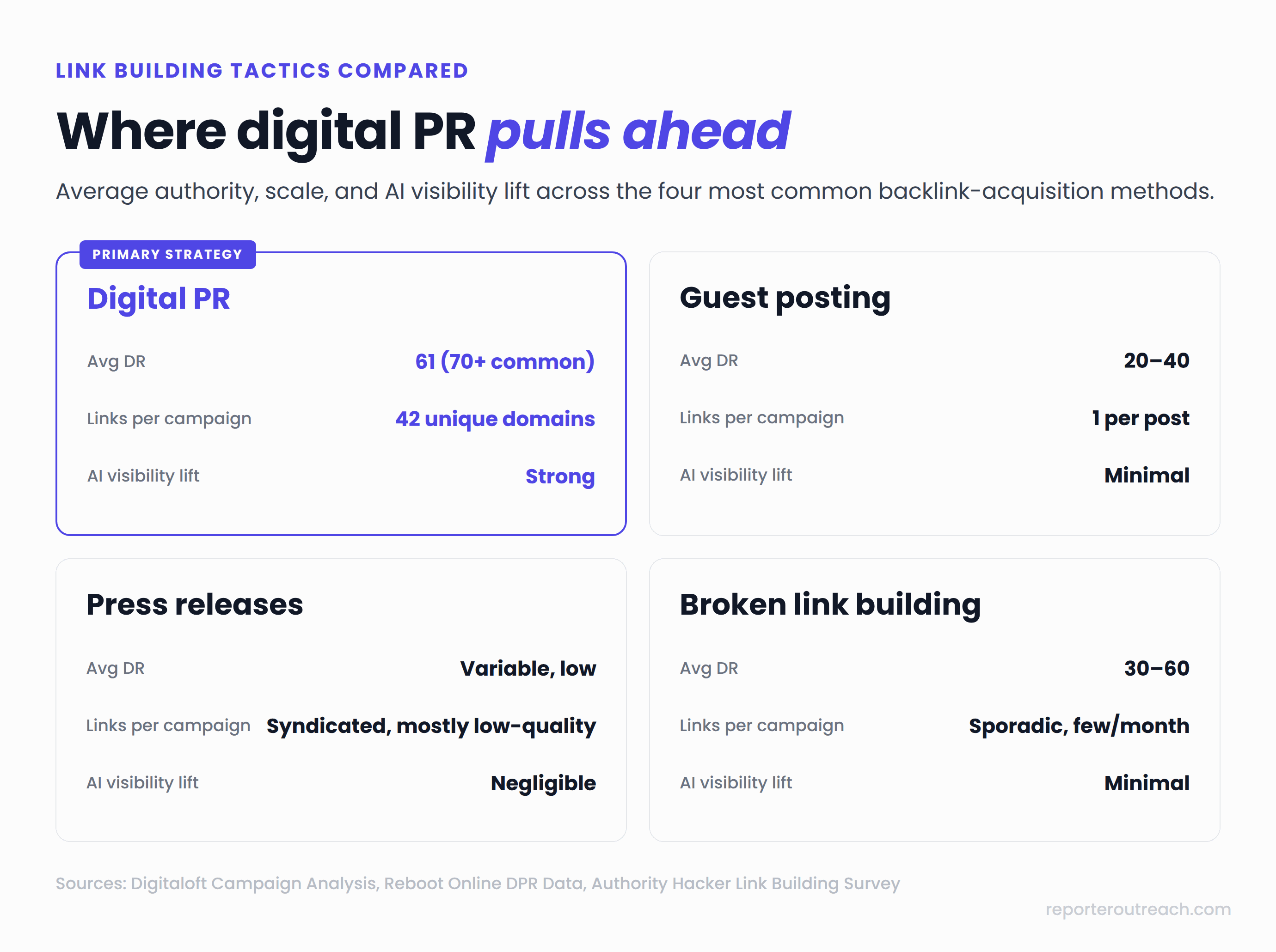
| Tactic | Avg DR | Links per campaign | AI visibility lift |
|---|---|---|---|
| Digital PR | 61 avg, 70+ common | 42 unique domains | Strong (editorial mentions) |
| Guest posting | 20-40 | 1 per post | Minimal |
| Press releases | Variable, mostly low | Syndicated, many low-quality | Negligible |
| Broken link building | 30-60 | Sporadic, few per month | Minimal |
The cost difference deserves context. Digital PR runs roughly $750 per earned link on average, compared to $100-500 for traditional outreach and $200-1,000+ for guest posts. But a single DR 80+ editorial mention carries more ranking impact — and significantly more AI visibility — than dozens of lower-authority placements. Digital PR also produces real referral traffic because placements appear on news sites with actual audiences.
Guest posting still has a role as a supporting tactic. But as the primary strategy? The data doesn't support it anymore. For the full comparison, see our digital PR statistics breakdown.
How a Digital PR Campaign Actually Works
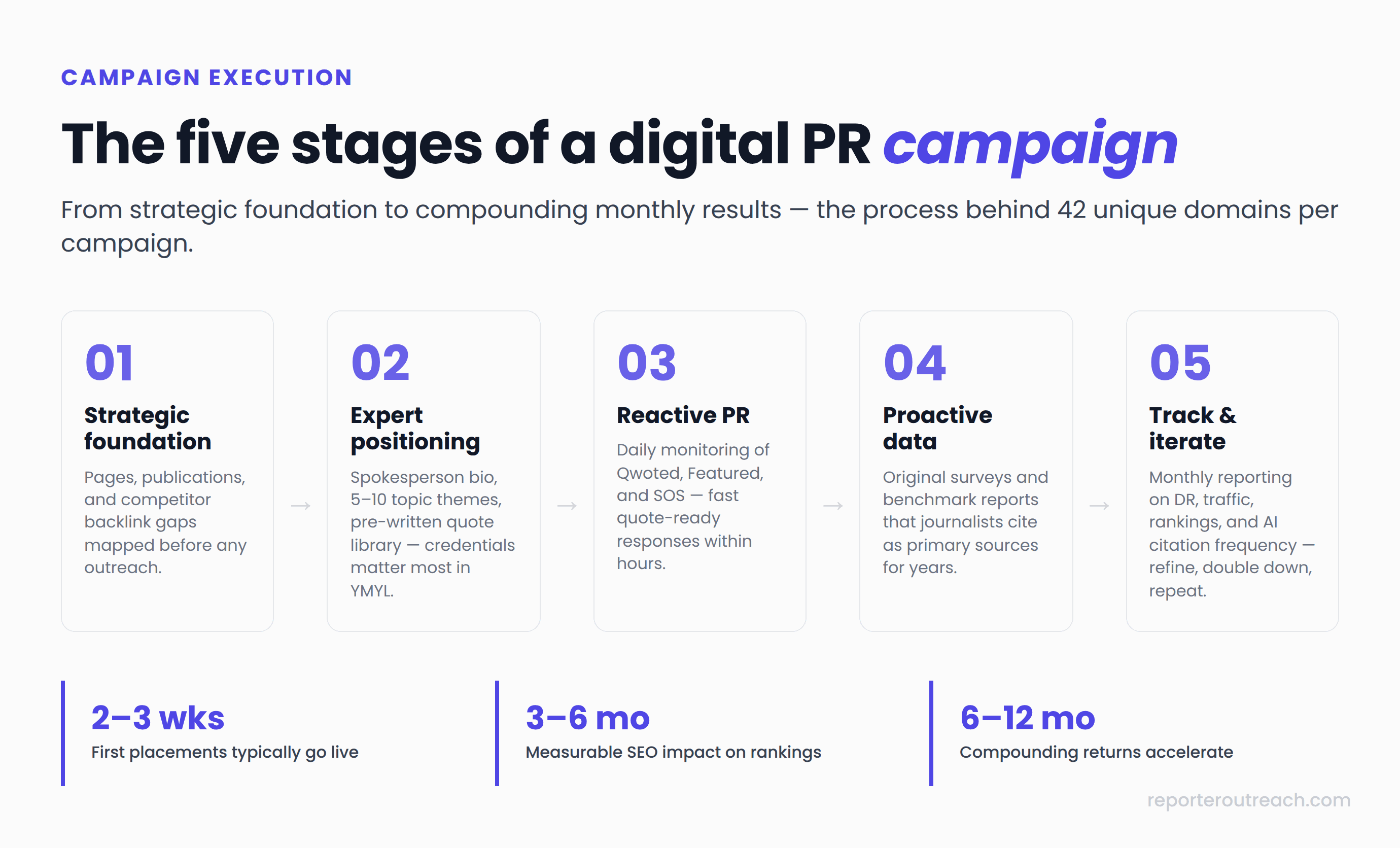
A successful campaign follows five stages. This isn't theoretical — it's the process behind the numbers above.
Stage 1: Strategic Foundation
Before any outreach happens, you need to know which pages need authority (service pages, homepage, key landing pages), which publications your audience reads and AI trusts, and where your competitor backlink profiles have gaps you can exploit.
Stage 2: Expert Positioning
Journalists quote people. Not brands, not companies — people with names and credentials. Your digital PR strategy needs a spokesperson who can deliver authoritative commentary on topics your target audience cares about.
This means an expert bio, 5-10 topic themes they can speak on, and a library of pre-written quotes for rapid deployment. In YMYL industries (healthcare, finance), the spokesperson's credentials are non-negotiable. A quote from a licensed clinician carries fundamentally different weight than one from a marketing manager.
Stage 3: Reactive PR
Journalists post queries looking for expert sources on platforms like Qwoted and Featured. Your team responds with polished, quote-ready answers within the window — sometimes hours. This is reactive PR — the model our digital PR services are built on: positioning our clients as expert sources in articles journalists are already writing.
The pitch data is clear. Only 2% of journalists want pitches over 400 words (Cision, 2025). Lead with the usable quote in the first sentence. Bio comes at the end. If the quote is strong, they'll look for it.
Stage 4: Proactive Data Campaigns
Reactive PR captures existing media demand. Proactive campaigns create new demand. Original surveys, benchmark reports, and data studies that journalists cite because they can't get the data anywhere else.
When your brand publishes the only publicly available data on a topic, every subsequent article links back to you. That's compounding — one dataset generating links for years. The best digital PR campaigns turn proprietary data into dozens of editorial placements across multiple publications.
Stage 5: Tracking and Iteration
Placements go live within 2-3 weeks. Each one is tracked for domain rating, referral traffic, relevance, and AI citation frequency. Monthly reporting ties placements to ranking improvements, organic traffic growth, and AI visibility changes. Then you refine: which publications produced the biggest impact, which pitch angles resonated, where to double down.
Real Results: Healthcare Digital PR
Healthcare is one of the most competitive verticals for digital PR — and one where the results are most dramatic, because Google's Helpful Content system applies heightened E-E-A-T scrutiny to health content. Brands without editorial validation from trusted health publications simply can't compete.
Take Villa Oasis, an addiction treatment provider competing in one of the toughest YMYL niches. Through reactive PR and expert positioning across mental health and recovery beats, the campaign earned editorial placements in Verywell Mind, PsychCentral, PopSugar, and LA Magazine — driving 352% organic traffic growth at an average DR 80, across nine months of consistent outreach.
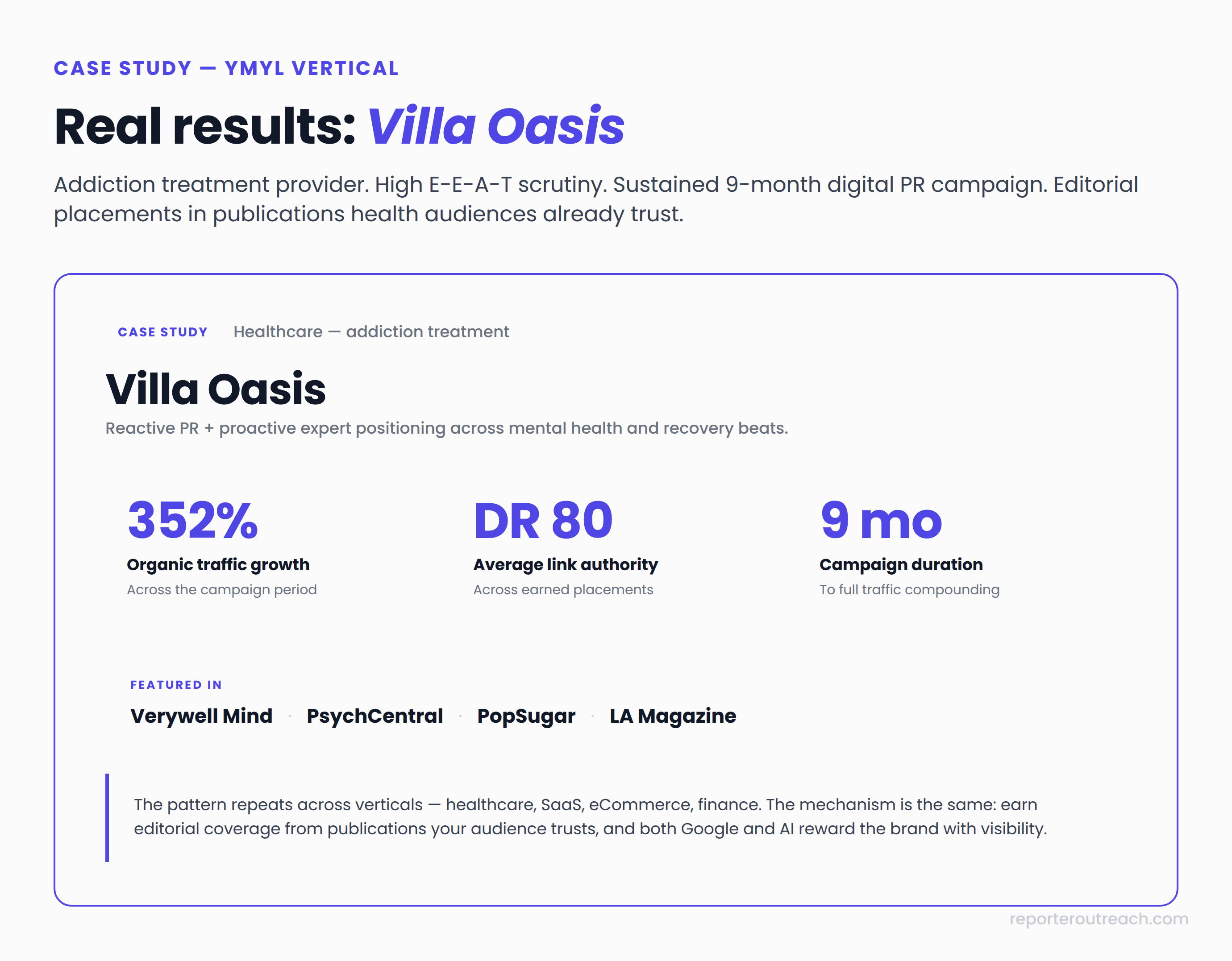
This pattern repeats across industries. Healthcare, SaaS, eCommerce, financial services — the vertical changes but the mechanism is the same: earn editorial coverage from publications your audience trusts, and both Google and AI reward you with visibility.
For industry-specific playbooks, see our guides on link building for SaaS, eCommerce, real estate, financial services, cybersecurity, food and recipe brands, and HR and recruiting.
Measuring What Actually Matters
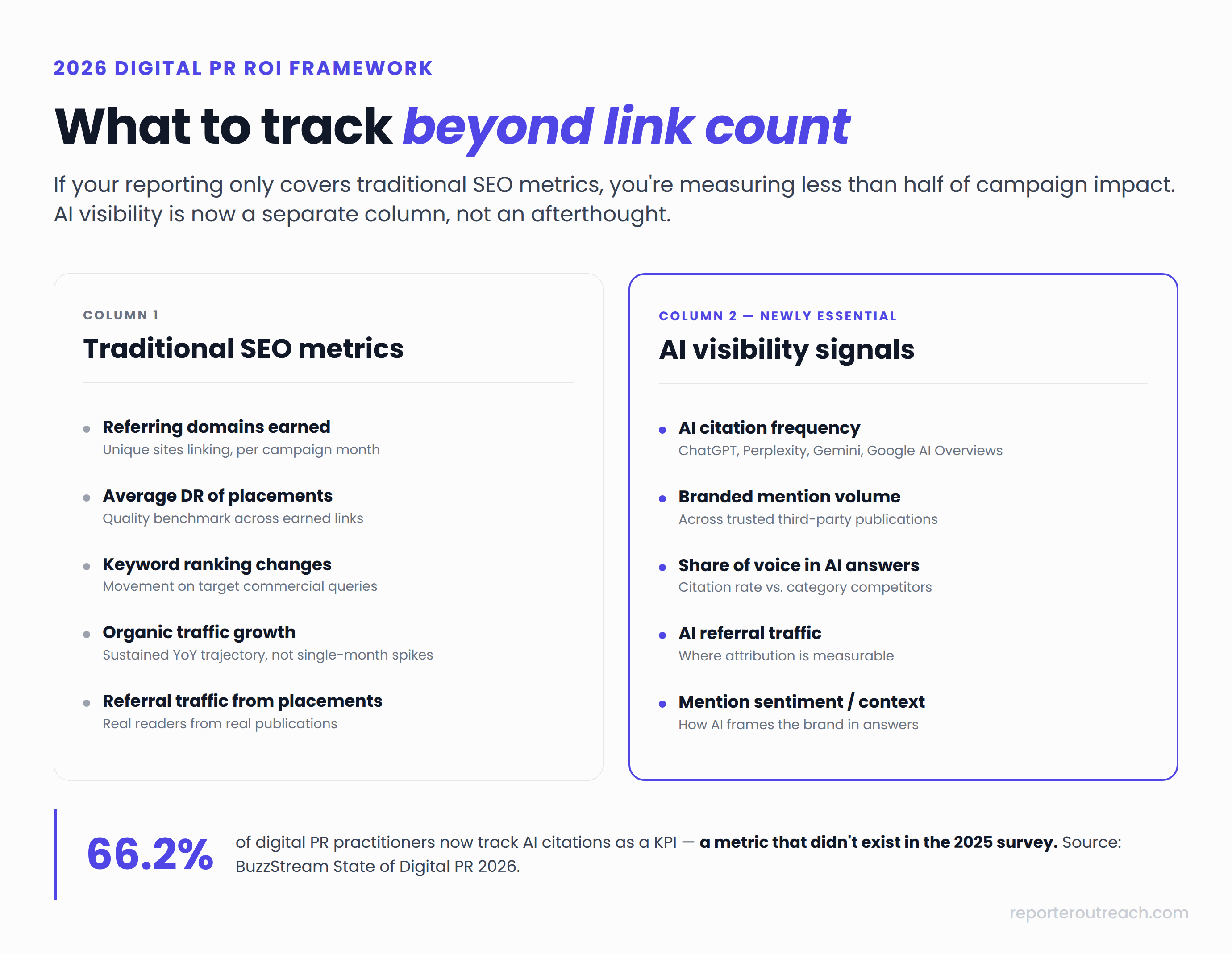
If you're only tracking link count, you're measuring maybe a third of the value digital PR produces. A complete ROI framework in 2026 covers both traditional SEO metrics and AI visibility signals.
| Traditional SEO metrics | AI visibility signals |
|---|---|
| Referring domains earned | AI citation frequency (ChatGPT, Perplexity, Gemini, Google AI Overviews) |
| Average DR of placements | Branded mention volume across trusted publications |
| Keyword ranking changes | Share of voice in AI-generated answers |
| Organic traffic growth | AI referral traffic (where measurable) |
| Referral traffic from placements | Sentiment / context of brand mentions in AI answers |
The AI visibility column is the one most teams are still ignoring. 66.2% of digital PR practitioners now track AI citations as a KPI (BuzzStream, 2026) — a metric that literally didn't exist in the 2025 survey. If you're not tracking this, you're measuring less than half of your campaign's impact.
Budget and timeline expectations
Most teams operate on $3,000-$12,000 monthly. The average cost per earned link is roughly $750, though more than half of teams can't report that metric accurately (BuzzStream). First placements appear within 2-3 weeks. Measurable SEO impact — ranking improvements, organic traffic growth — takes 3-6 months. The most significant results come from sustained campaigns over 6-12 months, with each month compounding on the last.
Minimum commitment is typically three months, because that's how long it takes to build media relationships and pipeline momentum. Month-to-month after that. For full pricing details, see our pricing page.
Mistakes That Kill Digital PR Campaigns
Treating it like advertising. Journalists want expert insight and original data. Not product pitches, not press releases. 86% will reject your pitch instantly if it's not relevant to their beat (Cision, 2025). The best campaigns provide genuine value to the journalist's story first — links follow as a byproduct.
Ignoring relevance for authority. A DR 90 link from a site that has nothing to do with your industry is worth less than a DR 60 link from an industry publication your audience reads. Google weights topical relevance. A healthcare brand needs links from health publications, not tech blogs.
Expecting overnight results. Month one builds relationships and pipeline. Months two through six are where placements accelerate and SEO impact becomes measurable. Brands seeing the strongest results have maintained consistent campaigns for 12+ months. Each editorial link makes future links more impactful because your domain authority is higher when they land.
Spray-and-pray outreach. Mass emailing generic pitches is the fastest way to get blacklisted by journalists. Personalized pitching to relevant reporters is table stakes. Quality of outreach directly determines quality of placements.
Not tracking AI visibility. 66.2% of the industry is already tracking AI citations. If your reporting only covers traditional SEO metrics, you're missing the fastest-growing channel in search marketing. Every editorial placement generates the brand mention signals AI uses to decide which brands to recommend.
Quantity over quality. 93.8% of link builders emphasize quality over quantity (Authority Hacker). One placement on a high-DR publication delivers more value than a dozen low-authority link exchanges. The brands that win are building fewer, better links — not more, weaker ones.
Skipping reclamation. About 20% of digital PR placements arrive without a hyperlink on first publish. Teams that don't audit for unlinked mentions and reach out to convert them lose the link value entirely. Unlinked brand mention reclamation is the back half of every campaign — not a separate tactic, not optional.
Frequently Asked Questions
What is digital PR link building?
It's the practice of earning editorial backlinks by getting your brand featured in real journalism — news sites, industry publications, and authoritative media outlets. Rather than asking other sites to add a link, you provide journalists with expert commentary and original data. They cite you because your expertise adds value to their story. The links are placed editorially, within real articles, by real reporters.
How much does a digital PR campaign cost?
Most teams spend between $3,000 and $12,000 per month, with 66.5% operating under $10K. The average cost per earned link is around $750, though more than half of practitioners can't accurately report this metric. Cost varies by industry, competition level, and campaign scope.
How long before results show up?
Initial placements usually go live within 2-3 weeks. Measurable SEO impact — ranking improvements, traffic growth — typically takes 3-6 months, with 85.2% of practitioners reporting results within that timeframe. The compounding effect means months six through twelve often produce the most dramatic gains.
How does digital PR help with AI search visibility?
AI systems like ChatGPT and Google's AI Overviews decide which brands to cite based on how often trusted publications reference them. Ahrefs data across 75,000 brands shows editorial mentions are 3x more predictive of AI visibility than link metrics alone, and Muck Rack found that 84% of AI citations come from earned media rather than paid or brand-owned content. Digital PR is the only tactic that generates these trust signals at scale.
Is digital PR better than guest posting?
For building authority and AI visibility, yes. Digital PR earns links from significantly higher-authority publications (avg DR 61 vs. 20-40 for guest posts), produces far more links per campaign (42 domains vs. 1 per post), and generates the brand mentions AI uses to validate brands. Guest posting still works as a supporting tactic, but the data shows digital PR as the more effective primary strategy.
Which industries benefit most?
Almost every vertical. Healthcare, finance, and other YMYL categories see outsized impact because Google holds those niches to stricter trust standards — and editorial coverage in publications journalists already trust is what clears that bar. SaaS brands lean on original research and tech newsjacking. eCommerce uses consumer trend data and seasonal angles. The connector: wherever journalists actively cover the space and AI search affects how buyers find vendors, digital PR moves the needle.
Sources: Ahrefs Brand Authority Study (75,000 brands, 2025), Muck Rack "What Is AI Reading?" (May 2026), BrightEdge AI Overviews Research (2026), BuzzStream State of Digital PR Report (2026), Cision State of the Media Report (3,000 journalists, 2025), Digitaloft Campaign Analysis (500 campaigns), Reboot Online Digital PR Data (2024), Reporter Outreach State of Link Building Survey (500 respondents, 2026), Authority Hacker Link Building Survey.
Build Authority That Ranks in Google and Gets Cited by AI
See how digital PR can drive editorial backlinks and AI visibility for your brand.