

Key Takeaways
- Recipe SEO in 2026 isn't about keyword density or schema tricks. The sites winning food search have editorial authority from publications Google and AI systems already trust — not just more recipes.
- Food & Drink saw the fastest growth in AI Overview triggers of any vertical in 2025 (+7.25%), and AI Overviews now reduce organic clicks by 58%. Recipe sites monetized through display ads face a direct revenue threat.
- The median food blogger earns $9,169/month — nearly all traffic-dependent. That income model breaks when AI generates recipes directly instead of linking to the sites that created them.
- Recipe schema remains one of the highest-performing structured data types for rich results, but schema alone doesn't build rankings. It makes your content eligible for rich results — domain authority determines whether you actually appear.
- Food media has a massive seasonal PR calendar that creates predictable, recurring opportunities for editorial coverage year-round — the kind of authority signals that both Google and AI systems use to decide which recipe sites to trust.
Recipe SEO has a counterintuitive problem. The sites with the best content — tested recipes, original photography, detailed nutritional data, properly implemented schema — often rank below sites with worse recipes and lazier photography. The difference isn't content quality. It's authority.
We've watched this pattern repeat across hundreds of food and recipe clients since 2017. A food blogger publishes 300+ original recipes, each with recipe schema markup, step-by-step photos, and nutritional breakdowns. Perfect on-page SEO. And they're stuck on page two behind Allrecipes, Food Network, and NYT Cooking — sites that sometimes have simpler recipes with stock photography. The missing variable is always the same: editorial backlinks from publications that Google trusts.
That was already a problem before AI search. Now it's existential. When someone asks ChatGPT for a chicken tikka masala recipe, the AI generates one directly. Zero clicks. Zero ad revenue. The only recipe sites that survive this shift are the ones AI cites as authoritative sources — and AI determines authority the same way Google does: by looking at who links to you and who mentions your brand.
Why Great Recipes Don't Rank
Food bloggers produce content prolifically. Two to five new recipes per week, each with original photography, structured instructions, and recipe schema. The content quality bar in food blogging is genuinely high — higher than most B2B or SaaS blogs, frankly.
But Google doesn't rank content in a vacuum. A recipe blogger with 500 original recipes and 50 referring domains will lose to a food media brand with 200 recipes and 5,000 referring domains. Every time. Google interprets backlinks as votes of confidence, and when Bon Appetit or Serious Eats links to a site, that trust applies at the domain level — lifting rankings for every recipe on the site, not just the one that earned the link.
Google's Helpful Content updates amplified this dynamic. Sites without strong editorial backlink profiles — even those with genuinely helpful content — saw significant traffic losses as Google increasingly requires external authority signals to validate quality. The food sites that weathered those updates weren't the ones with the most recipes. They were the ones with editorial links from recognized food publications.
This is what makes recipe SEO different from most verticals. In SaaS or eCommerce, content creation is usually the bottleneck. In food, the bottleneck is authority. Publishing more recipes when you lack domain authority is like building more shelves in a store nobody can find.

AI Search Is Rewriting the Rules for Recipe Sites
Here's why this is urgent, not just important.
Semrush analyzed over 10 million keywords and found that Food & Drink had the fastest growth in AI Overview triggers of any vertical — jumping 7.25 percentage points since March 2025 to sit right around 11% of food keywords triggering an AI Overview. Some independent analyses put Food & Beverage AI Overview triggers even higher, around 50% for certain query types. And when an AI Overview appears, organic clicks drop by 58% according to Ahrefs' February 2026 data.
For recipe sites, the math is brutal. The median food blogger earns $9,169 per month according to RankIQ's survey of 803 bloggers. Display advertising accounts for 42-44% of that revenue. All of it is traffic-dependent. When AI generates a recipe directly instead of linking to the site that perfected it — and that's exactly what happens when you ask ChatGPT or Google AI Mode for a recipe — the entire monetization model breaks.
But here's what most recipe SEO guides miss: AI systems don't randomly choose which sources to cite. They choose based on the same authority signals Google uses — editorial mentions in trusted publications, consistent brand presence across the web, and domain-level trust. The recipe sites that AI cites are the ones with editorial backlinks from food media. Everyone else gets replaced.

The Technical Foundation: What Schema Actually Does (and Doesn't)
Let's be direct about recipe schema, because there's a persistent myth that schema is ranking magic. It's not.
Recipe schema (JSON-LD structured data) makes your content eligible for rich results — the recipe cards with star ratings, cook times, and calorie counts in Google search. After Google's March 2026 core update, Recipe remains one of the highest-performing schema types. That eligibility matters for click-through rates. It does not directly improve ranking position.
Google clarified this distinction in mid-2025 when they updated their Recipe structured data documentation. The image property in Recipe markup doesn't affect which image appears in regular organic text results — only in Recipe Rich Results. Schema is a visibility layer on top of rankings, not a replacement for the authority signals that determine rankings in the first place.
Recipe schema earns you rich result eligibility (the visual recipe cards in search), which improves CTR once you rank. AI Mode also reads structured data as a trust signal during answer synthesis. But schema without domain authority is like a beautiful storefront on a street nobody drives down — visible to anyone who finds you, invisible to everyone else.
That said, recipe schema is table stakes. If you're running a recipe site without it, fix that before doing anything else. The technical implementation is straightforward — JSON-LD with your recipe name, ingredients, instructions, cook time, prep time, yield, nutrition, and image. Use Google's Rich Results Test to validate. Most WordPress recipe plugins (WP Recipe Maker, Tasty Recipes) handle this automatically.
What schema can't do is solve the authority problem. And the authority problem is what's actually holding most food sites back from ranking.
What Actually Ranks Recipe Content in 2026
We've run digital PR campaigns for food and recipe sites since 2017. Here's what matters most, ranked by impact:
Editorial backlinks from food publications. A link from Epicurious, Serious Eats, or Taste of Home tells Google that a recognized authority trusts your content. This trust applies domain-wide — one strong editorial link can improve rankings across dozens of recipe keywords simultaneously. These are also the publications AI systems reference when deciding which recipe sites to cite.
Topical authority through content depth. Google's systems increasingly assess whether your site covers a topic comprehensively. A recipe blog that covers an entire cuisine — dozens of recipes, technique guides, ingredient deep dives — will rank individual recipes better than a site with scattered coverage across every cuisine. This is recipe SEO at the structural level: your site architecture and content clusters matter as much as individual recipe optimization.
E-E-A-T signals tied to a real person. Google applies more scrutiny to recipe content when it touches nutrition, food safety, or dietary advice. Having a named author with demonstrable culinary expertise — cookbook credits, culinary school training, restaurant experience, nutrition certifications — meaningfully impacts how Google evaluates your content. Author pages with credentials, linked across your recipes, aren't optional anymore.
Core Web Vitals and page experience. This matters more for recipe sites than most verticals because food blogs tend to be heavy — display ads, high-resolution images, auto-playing videos, sticky units. Slow load times and layout shifts kill recipe page rankings. The food bloggers who've maintained traffic through recent updates tend to run lean, fast pages with ad placements that don't push the recipe card below the fold.
Recipe schema (correctly implemented). Rich result eligibility is necessary but not sufficient. The sites that appear in recipe rich results aren't the ones with the best schema — they're the ones with the best schema AND sufficient domain authority to rank in the first place.

How to Build the Authority Recipe Sites Actually Need
On-page recipe SEO — schema, internal linking, keyword placement — is well-documented. Every food blogging course covers it. What almost none cover is the off-page authority building that determines whether your recipes rank. Here's what works:
Reactive PR through journalist sourcing platforms
Food journalists on Qwoted, Featured, and similar platforms post queries constantly. "Looking for a pastry chef to explain why sourdough starters fail." "Need a nutritionist to comment on the latest diet trend." "Seeking a food blogger's take on Thanksgiving shortcuts that actually work." These are free, recurring opportunities to earn editorial placements in the publications that move the needle for recipe SEO.
The pitch isn't "here's my recipe." Journalists don't need your recipe — they can find thousands. They need your unique perspective on why a technique works, what food trends you're seeing in your audience data, or which common cooking advice is flat-out wrong. A food blogger who can explain the science behind why bread rises differently at altitude will consistently win placements over someone sending a recipe link.
Original food data that journalists can't get elsewhere
If your recipe site gets meaningful traffic, your analytics contain stories journalists want to tell. What's trending in your recipe searches? Which cuisines are growing fastest year-over-year? What ingredients are people substituting most? Which "healthy" recipes do people actually cook versus just bookmark?
This kind of original data — anonymized and packaged into a digestible report — gives food journalists a story nobody else can provide. Annual "most-searched recipes" reports, seasonal ingredient trend analyses, cooking behavior surveys. One well-executed data study can earn backlinks from dozens of food publications and keep attracting citations for years.
Seasonal PR campaigns aligned to the food calendar
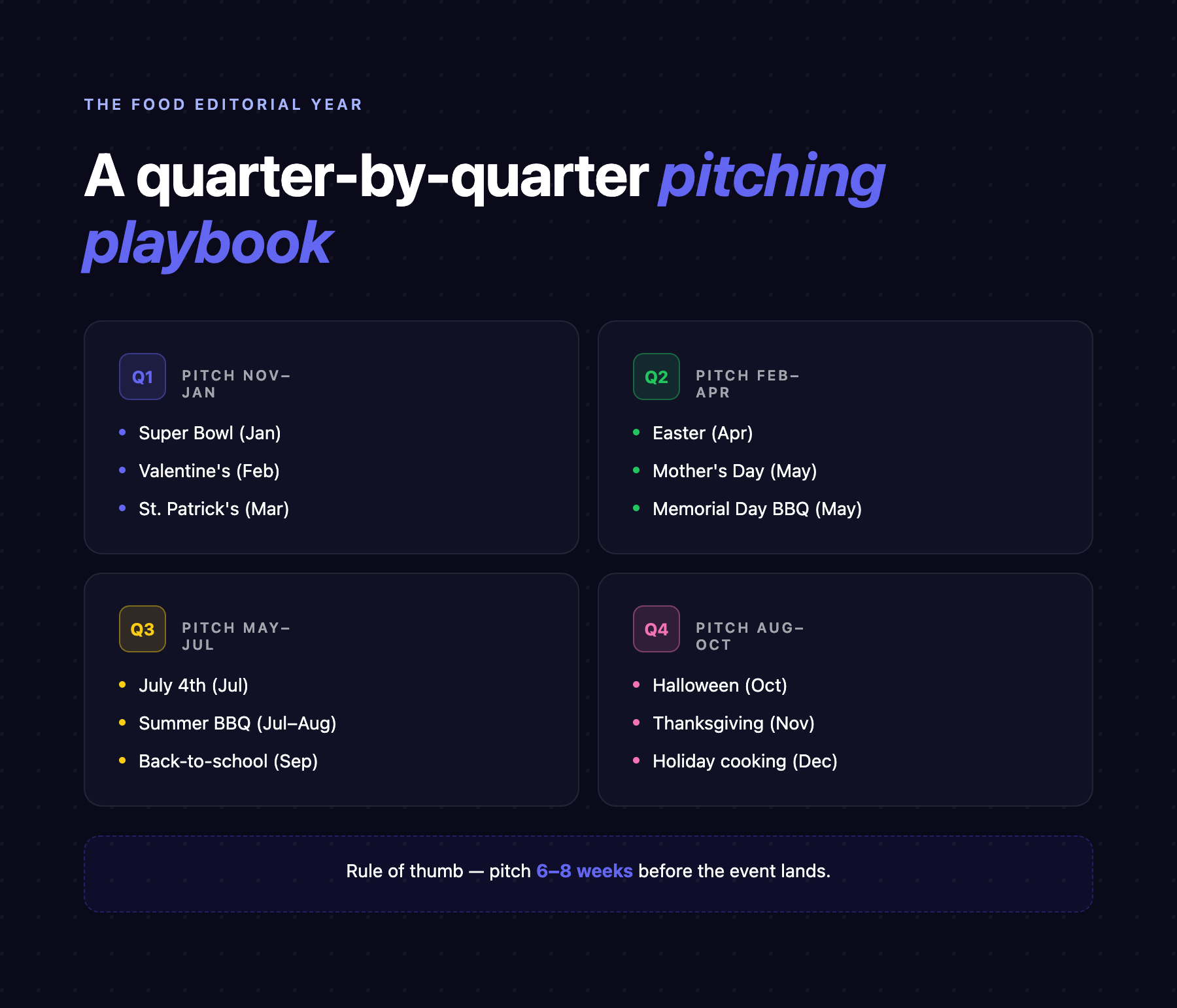
Food sites have an advantage no other vertical can match: the food calendar creates predictable, recurring PR opportunities that reset every year. Thanksgiving, holiday baking, New Year health resets, Super Bowl party food, grilling season, back-to-school lunches. Journalists write these same seasonal stories annually — and they need fresh expert angles, updated data, and new sources each time.
The critical insight: food journalists plan content 4-8 weeks ahead of seasonal events. If you pitch your Thanksgiving expertise in November, those articles were assigned in September. A year-round seasonal PR calendar means your brand earns consistent editorial placements every month, not just during holidays.
Link insertions into existing food roundups
Food content is full of "best of" roundups, recipe collections, and ingredient guides that already rank. Link insertions place your site into these existing articles — getting your recipes or expert content featured in pieces like "25 Best Slow Cooker Recipes" or "How to Meal Prep for the Week" that are already on page one. The host site's domain authority is what gives these placements their value, and food publications tend to carry high DR due to their massive audiences.
5 Recipe SEO Mistakes That Keep Food Sites Stuck
Publishing more recipes instead of building authority. When traffic drops, the instinct is to publish more content. But if the issue is domain authority — and for most food blogs, it is — 50 new recipes won't help. That time and budget would be better spent on 10 editorial backlinks that lift the entire site.
Treating food blogger link exchanges as link building. Food bloggers frequently link to each other's recipes, which feels collaborative but does little for authority. Google's SpamBrain increasingly flags these reciprocal patterns, and the links come from sites with similar (low) domain authority. You need links from outside the food blogger ecosystem — from food media, lifestyle publications, health outlets — to actually move the needle.
Optimizing schema without optimizing authority. Perfect recipe schema on a DR 20 site is like a perfectly formatted resume that nobody reads. Schema makes your content eligible for rich results once you rank. It doesn't make you rank. The food bloggers who obsess over schema implementation while ignoring their backlink profile have the recipe SEO equation backwards.
Missing seasonal pitch windows by 6-8 weeks. Thanksgiving content goes live in September. Summer grilling guides get assigned in April. If you're pitching seasonal content the month of the event, you're two months too late. A year-round PR calendar aligned to journalist planning cycles is essential.
Ignoring AI visibility until traffic is already gone. If ChatGPT generates a recipe instead of linking to yours, no amount of on-page optimization recovers that traffic. Building editorial presence now — before AI search fully matures — ensures your brand is one that AI cites rather than replaces.

What It Costs and What You Get
Food sites have an unusually clear ROI model: organic traffic equals ad revenue. Every ranking position gained translates directly to monthly income.
At $20-$40 RPM through premium ad networks like Raptive or Mediavine, 10,000 additional monthly sessions from improved rankings generates $200-$400/month in recurring revenue — with no additional cost after the editorial links are built. Food keywords are generally less competitive than YMYL verticals like finance or health, which means the authority threshold for ranking is lower. A monthly digital PR investment of $3,000-$6,000 that produces meaningful ranking improvements typically pays for itself within a few months through additional ad revenue alone.
Editorial placements in national food publications also elevate your brand with ad networks and sponsors. Sites featured in recognized food media command higher CPMs and better sponsorship deals than sites with equivalent traffic but no editorial presence. The authority compounds.
Getting Started
1. Audit your backlink profile. How many of your links are from other food blogs (limited value) versus editorial food publications (high value)? Compare your referring domain count and DR against the food sites ranking above you for your target recipe keywords.
2. Define your expertise angle. "I'm a food blogger" isn't a pitch. "I'm a trained pastry chef who specializes in high-altitude baking" is. The more specific your expertise, the more likely journalists choose you as a source.
3. Fix your technical foundation. Recipe schema, Core Web Vitals, site speed. These are table stakes — not differentiators — but you can't rank without them.
4. Check your AI visibility. Ask ChatGPT and Perplexity to recommend recipe sites in your niche.If competitors appear and you don't, you need the editorial coverage that builds AI citation potential.
5. Build your seasonal PR calendar. Map every major food event to a pitch window 4-8 weeks ahead. Pre-write expert perspectives so your team can pitch quickly when journalist queries appear.
Build Authority for Your Recipe Site
We'll run a free backlink analysis and show you how your editorial profile compares to the food sites outranking you.
Frequently Asked Questions
Does recipe schema directly improve Google rankings?
Recipe schema makes your content eligible for rich results — the visual recipe cards with ratings, cook times, and calories. That improves click-through rates once you rank, but it doesn't determine your ranking position. Domain authority, editorial backlinks, and content depth are what determine whether you rank high enough for rich results to matter.
Why is AI search particularly threatening for recipe sites?
When someone asks an AI for a recipe, the AI generates one from its training data — complete with ingredients and instructions. No click to any recipe site. Since most food bloggers monetize through display ads (which require page views), AI-generated recipes directly eliminate their revenue. The only defense is building the editorial authority that makes AI cite your site as a trusted source rather than replacing it.
Do I need culinary credentials for editorial PR?
Culinary school training, cookbook authorship, restaurant experience, and nutrition certifications all increase placement rates with journalists. But demonstrated expertise works too — years of recipe development in a specific area, a track record of testing techniques, or unique audience data. A vague "food enthusiast" pitch goes nowhere, but "sourdough specialist who has tested 200+ starter variations" gets placed.
How long before editorial backlinks improve recipe rankings?
The competitive threshold for ranking in food search is lower than in finance or health, which means authority improvements show up faster. Most food sites see measurable ranking movement within 2-4 months of consistent editorial link building. Placements themselves often happen within a few weeks because food media operates on fast publishing cycles. And because domain authority is site-wide, one strong editorial placement improves ranking potential across your entire recipe catalog.
Is recipe content considered YMYL by Google?
Standard recipe content typically isn't classified as Your Money or Your Life content. But nutritional advice, diet-specific recommendations, food safety guidance, and allergy information can trigger elevated scrutiny. If your site publishes content about specific diets or makes health claims, Google applies higher E-E-A-T standards — making editorial backlinks from trusted food and health publications significantly more important.
Can link building help after a Google core update traffic loss?
If your traffic dropped after a Helpful Content or core update, Google likely re-evaluated your site's trustworthiness relative to competitors and found the editorial signals lacking. A backlink audit can reveal whether your profile is over-weighted toward low-authority food blog links and missing the editorial placements Google now requires. Rebuilding that editorial foundation is the most direct path to recovery.
Sources
- RankIQ — Food Blog Income and Traffic Study (803 bloggers surveyed; median income $9,169/mo)
- Semrush — AI Overviews Impact Study (10M+ keywords; Food & Drink fastest-growing vertical at +7.25%)
- Ahrefs — AI Overviews reduce organic clicks by 58% (February 2026)
- Google Search Central — Recipe Structured Data documentation update (June 2025)
- Digital Applied — Schema Markup After March 2026 (Recipe schema among highest-performing types)
- Reporter Outreach — Campaign performance patterns, 500+ food and recipe site clients (2017-2026)