Key Takeaways
- Newsjacking is reactive digital PR — positioning your brand as an expert source when a relevant story breaks. Done well, it earns editorial backlinks from DR 70-90+ publications.
- The window is 4-24 hours after a story breaks. By the 48-hour mark, most journalists have filed their pieces and moved on.
- Earned editorial coverage drives 84% of all AI citations across ChatGPT, Claude, and Gemini (Muck Rack, May 2026). Newsjacking generates exactly that kind of coverage.
- The brands that win at newsjacking have systems, not reflexes — monitoring stacks, pre-approved spokespeople, pitch templates, and reporter relationships built before the news breaks.
David Meerman Scott coined "newsjacking" in 2011 to describe a social media tactic — post a clever tweet when a story breaks, ride the trending topic, get noticed. That was the whole playbook.
Newsjacking in 2026 looks nothing like that. It's a reactive digital PR strategy that earns editorial backlinks from the highest-authority publications on the web. When a story breaks in your industry, reporters at Forbes, Business Insider, and trade outlets are scrambling for expert sources to round out their follow-up coverage. If your brand delivers a useful quote inside the response window, you earn editorial coverage — and the high-DR backlink that comes with it.
PR pitching still drives a real share of the news cycle. According to Muck Rack's 2026 State of Journalism survey of nearly 900 journalists, 86% say at least some of their published stories started with a PR pitch. Newsjacking is the version of pitching that's tied to a story already on the wire.
This guide covers how to build a repeatable newsjacking system, which stories are worth pursuing, how to pitch reporters, and how to combine reactive and proactive PR for the strongest results.
How Newsjacking Actually Works
The link building opportunity sits inside a single 4-24 hour window after a story breaks. Most brands miss it because they don't understand the lifecycle.
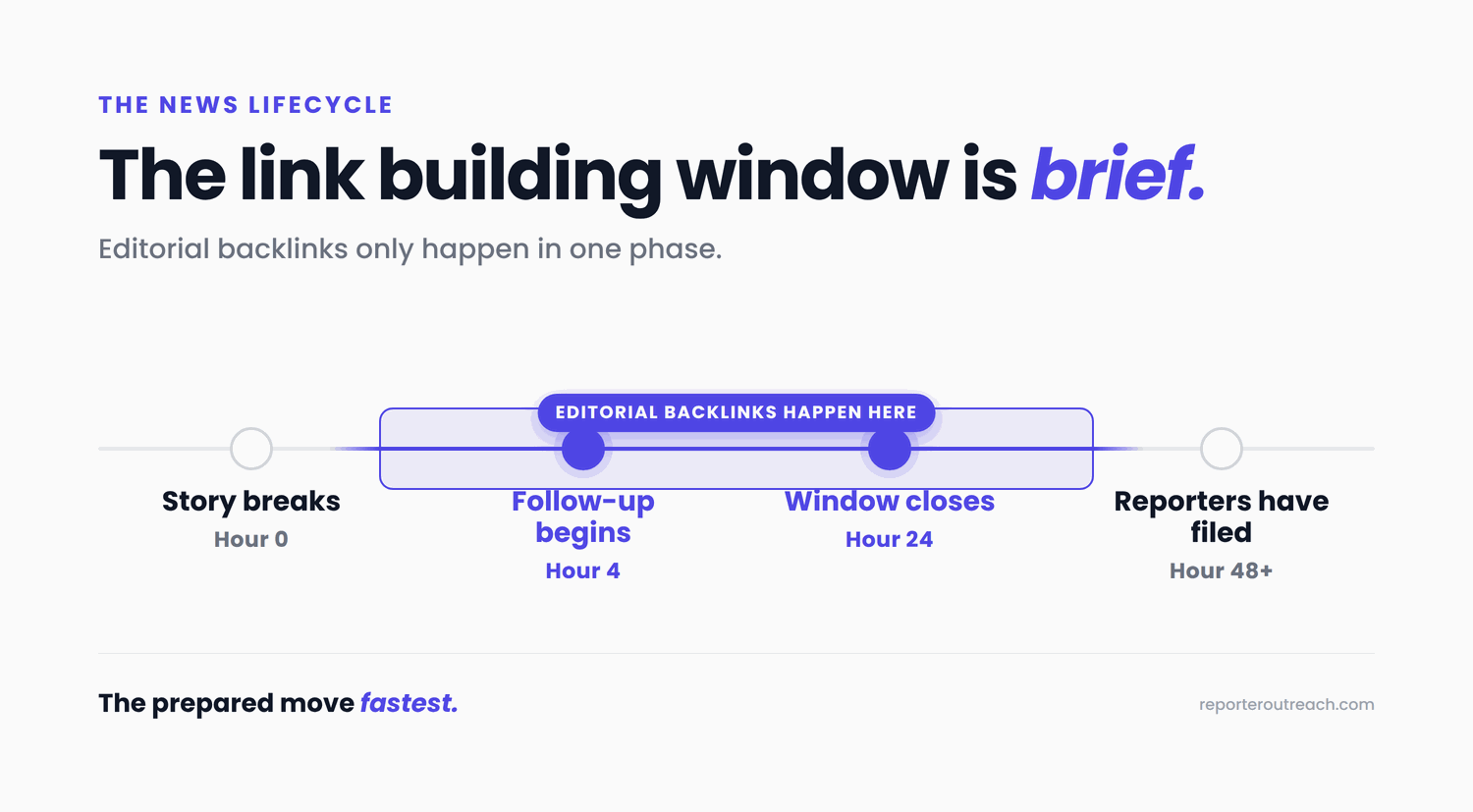
The follow-up phase is where backlinks happen. During this window, journalists at major publications are scrambling for fresh angles and expert commentary to differentiate their coverage from the wire copy. If you can provide a credible expert quote, a relevant data point, or a sharp analytical perspective, the writer includes it — with attribution and a backlink.
These aren't guest posts or paid placements. They're editorial links inside real news coverage, which makes them some of the most valuable backlinks available. Publications covering breaking stories typically sit at DR 70-90+, and the editorial nature of the placement means the link carries maximum weight in search algorithms.
After 48 hours, the window closes. The same pitch that would have landed in hour 6 gets ignored in hour 60.
Links vs. Social Media
The traditional view of newsjacking — posting a clever tweet when a story trends — still has some brand awareness value. But the ROI comparison with link-focused newsjacking isn't close.
| Dimension | Social newsjacking | Editorial newsjacking |
|---|---|---|
| Half-life | Hours | Years (link stays live) |
| Reach | Your existing followers | Publication's audience (often 10-100x your own) |
| SEO impact | None | DR 70-90+ editorial backlinks |
| AI visibility signal | Weak | Strong — earned coverage drives most AI citations |
| Measurability | Engagement, occasional traffic | Direct ranking lift, brand mention tracking |
The best approach is both: share a social post for immediate visibility while pitching expert commentary to reporters. But if you have to choose, pitch the reporter. A single editorial backlink from a DR 80+ publication has more measurable impact than any number of social impressions.
Building a Newsjacking System
Speed is a function of preparation, not creativity. The brands that consistently earn newsjacking links aren't the ones with the fastest creative team — they're the ones whose systems make rapid response automatic.
A working newsjacking system has four components:
- Monitoring stack. You can't newsjack what you don't see. Set up Google Alerts for your core keywords, competitor names, and regulatory bodies in "as it happens" delivery (not daily digest). Check Google Trends daily for spikes in your niche. Build Twitter/X lists of reporters and trade accounts — stories often surface there before they hit the wire. Most importantly, subscribe to journalist sourcing platforms like Qwoted, Featured, and Source of Sources. These push source requests directly to you when reporters need expert commentary, and they're the most direct path to an editorial backlink.
- Pre-approved spokespeople. Speed requires pre-approval. Identify 2-3 people at your company who can serve as expert sources and get blanket approval for them to be quoted on topics within their authority. If every quote needs a three-day review chain, you'll miss every window. For each spokesperson, prepare a bio, headshot, and list of topics they can speak on — ready to send.
- Pitch templates. Don't write from scratch for every opportunity. Build templates for common scenarios — a regulatory change, a major event, a new report, a viral consumer story. Each template should have a structure (lead insight, supporting data point, one-line expert bio) that can be customized in under 15 minutes. Templates are the difference between a 30-minute response and a 3-hour scramble.
- Reporter relationships. The highest-converting pitches go to journalists who already know you. Build a database of reporters who cover your industry — note their beats, recent stories, and previous interactions. The worst time to start building reporter relationships is when you're trying to newsjack a story everyone else is pitching too. Our media outreach guide covers the relationship-building piece in depth.
When a story breaks, reporters post source requests on platforms like Qwoted and Featured within hours. These are essentially invitations to newsjack — the journalist is telling you exactly what they need. Responding to source requests is the most efficient form of newsjacking because the writer has already signaled intent. This is how most productive reactive PR actually works in practice.
Which Stories Are Worth Pursuing
The brands that waste the most time on reactive PR are the ones that pitch every story. Picking the right story is what separates productive newsjacking from spray-and-pray.
The selection rule: does this story create a credible reason for a reporter to want my expert's perspective?
| Pursue | Skip |
|---|---|
| Industry-relevant stories: regulations, M&A, market shifts, research releases | Tragedies and disasters where your expertise isn't directly relevant |
| Broader stories with a clear, immediate connection to your authority | Politically divisive topics |
| Predictable events: tax season, back-to-school, conference cycles | Stories where the facts are still evolving |
| Source requests on Qwoted/Featured matching your spokespeople's beats | Stories where your connection requires a three-sentence justification |
Industry-relevant stories are the highest-conversion opportunities because reporters need specific expertise that only practitioners can provide. A new SEC ruling, a major acquisition, a fresh research study — these create demand for the exact kind of commentary your spokespeople can deliver.
Broader stories can work too, but the connection must be genuine and immediately obvious. A viral consumer story that relates to your product category. An economic trend that affects your customers. Reporters spot forced relevance instantly — if the connection requires three sentences to explain, it's too much of a stretch.
Predictable events deserve their own preparation. Tax season, back-to-school, holiday shopping, conference season — these aren't breaking news, but they generate predictable waves of coverage you can prepare for in advance. A financial services brand can craft tax-season commentary weeks ahead and deploy it the moment coverage begins.
What to avoid: tragedies where opportunism is the bigger risk than the upside, politically divisive topics (which rarely produce the balanced coverage that earns backlinks), stories with evolving facts (commenting on incorrect early reports creates reputational risk), and stories with no credible connection to your expertise. A stretched pitch damages your credibility with that reporter for every future opportunity.
How to Pitch a Newsjacking Response
A newsjacking pitch is a useful quote with a name attached — not a sales pitch. Shorter, faster, immediately usable.
Journalists are explicit about what they want. Muck Rack's 2026 survey found that 69% of journalists prefer pitches under 200 words, and 40% specifically value original data over generic commentary. For newsjacking, where reporters are on deadline, the bar for brevity is even higher.
A working pitch has five components:
- Subject line. Reference the news event by name. "[Story name] — expert commentary available" or "[Specific angle] on [story]" beats anything cute or generic.
- Lead insight. First sentence delivers a usable take on the story. Not "we'd love to help with your coverage" — actual analysis. If the reporter pastes your first sentence into their piece, they should have a quote.
- Supporting data or proprietary angle. One data point, one observation, or one perspective the reporter likely hasn't heard. This is what separates your pitch from the dozens of generic takes on the same story.
- Expert bio. One sentence: name, title, company, and what makes them qualified to speak on this specific story. Headshot link and longer bio available on request.
- Clear next step. Available for phone or email within X hours, willing to provide additional data, can be on camera by Y time. Make it frictionless to use you.
Reading the components as a checklist is one thing — seeing how they sit inside an actual pitch is another. Here's the same five-part structure in context:

The most common mistake: pitching your product instead of providing useful insight. Reporters want a quote for their story, not a promotional paragraph. If the journalist finds your commentary valuable, they'll include your name, title, and brand naturally — that's how the brand mention and backlink happen. The link is the byproduct of being genuinely helpful, not the request.
The second most common mistake: pitching the same angle as everyone else. If the story is big, dozens of brands are sending generic takes. Differentiate with proprietary data, a contrarian perspective, or an angle the reporter hasn't considered. The 40% of journalists who specifically look for original data are the same journalists who write the highest-DR stories.
Newsjacking and AI Search Visibility
Newsjacking matters more in 2026 than it did five years ago because of how AI search systems decide which brands to cite.
Muck Rack's May 2026 What Is AI Reading? study analyzed more than 25 million links cited by ChatGPT, Claude, and Gemini across 17 industries. The headline finding: earned media drives 84% of all AI citations. Paid content — advertorials, sponsored placements — accounts for just 0.3%.
That gap is the case for newsjacking on its own. AI engines aren't reading press releases, brand-owned blogs, or paid placements when they decide which brands to recommend. They're reading editorial coverage on high-authority domains. Newsjacking is one of the few link building methods that generates exactly that signal — a brand mention inside a real news story on a publication AI models trust.
A successful newsjacking placement has a triple payoff:
No other link building strategy simultaneously delivers all three. For the full framework on how brand mentions translate to AI visibility, see our generative engine optimization guide.
Reactive PR vs Proactive PR
Newsjacking (reactive PR) and proactive PR campaigns (data studies, contributed articles, strategic digital PR) aren't competing strategies — they're complementary.
| Dimension | Reactive (newsjacking) | Proactive (campaigns) |
|---|---|---|
| Predictability | Low — depends on news cycle | High — runs on your timeline |
| DR ceiling | Very high (DR 80-90+ tier-1) | Moderate (DR 60-80 mix) |
| Speed to placement | Hours to 48 hours | Weeks to months per campaign |
| Volume | Sporadic | Steady, planned |
| Angle control | Low — story shape isn't yours | High — you set the narrative |
Plotted against the two dimensions that matter most to most teams — how predictable the work is, and what kind of publications it reaches — the two approaches occupy genuinely different territory:
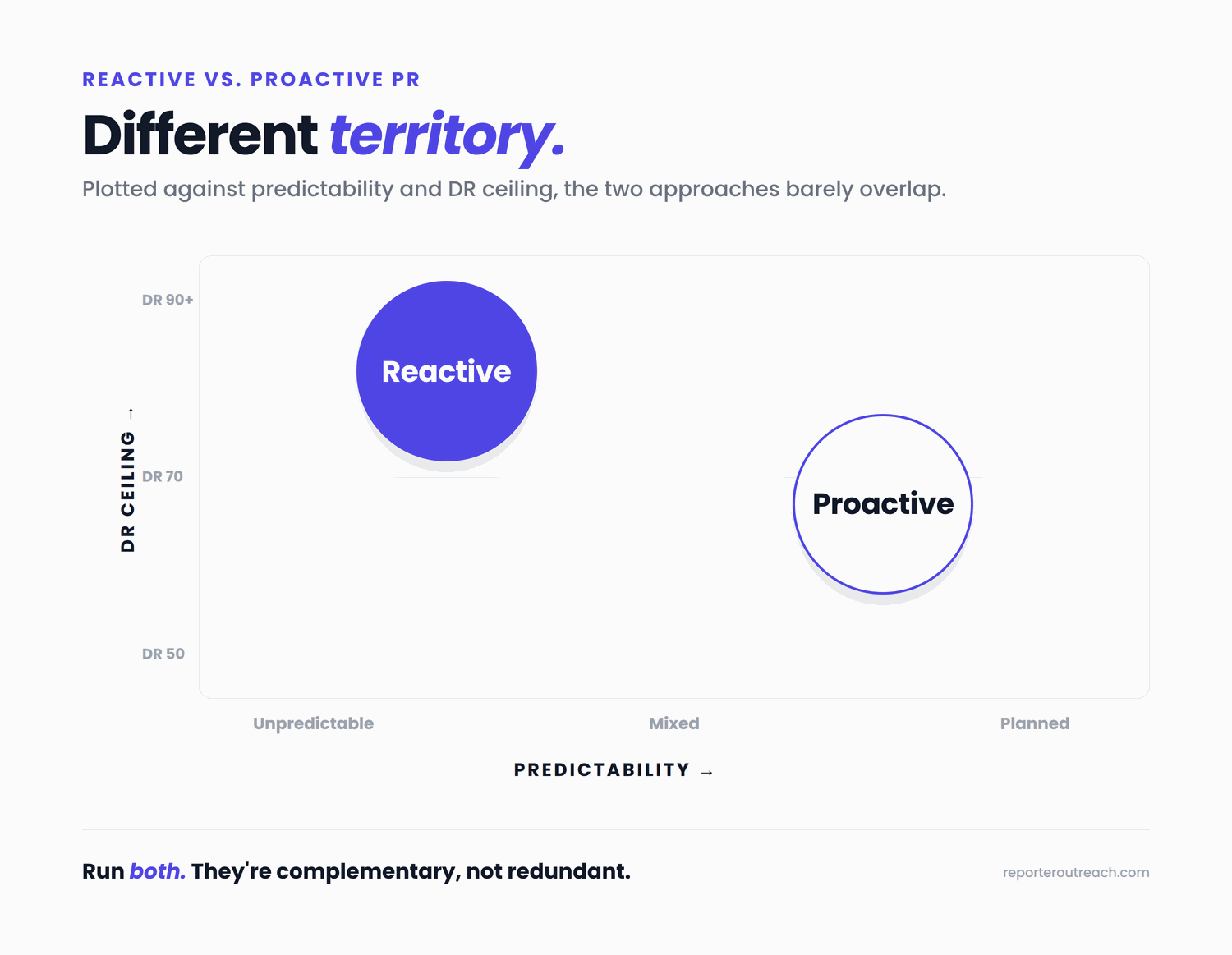
Reactive PR captures unpredictable spikes. When relevant stories break, you earn high-authority editorial links quickly — sometimes within 24-48 hours. The upside is speed and the potential for DR 80-90+ placements that proactive outreach struggles to access. The downside is unpredictability: you can't control when the right story will break.
Proactive PR creates steady, predictable link acquisition. Original data studies, expert surveys, and strategic outreach produce links on your timeline. The trade-off is that proactive campaigns rarely hit the same DR ceiling as reactive placements covering major news.
The strongest results come from running both. Proactive campaigns build your baseline authority. Reactive newsjacking captures high-value opportunities that proactive campaigns can't predict — the breaking story that earns you a placement in a tier-1 publication you'd never access through a cold pitch.
What This Looks Like in Practice
A combined reactive/proactive approach is what produced one of our SaaS engagements: Qooper, a mentoring platform competing against established HR tech brands. Their founder was positioned as an expert source on workplace mentoring, employee development, and remote work culture — proactively to journalists covering those beats and reactively to source requests on platforms like Qwoted. The result was 2,203% organic traffic growth in six months from editorial coverage averaging DR 78.
The pattern isn't unique to SaaS. Any vertical with credible spokespeople and a relevant news cycle can run the same play — combining proactive campaign work for baseline authority with reactive newsjacking for the high-DR opportunities that only the news cycle creates. See more case studies.
Turn Breaking News Into Editorial Backlinks
Our team monitors source platforms daily, pitching your experts to reporters covering trending events.
Frequently Asked Questions
What is newsjacking?
It's the practice of positioning your brand as an expert source when a relevant news story breaks. Rather than creating your own story, you respond to one that's already generating coverage — offering journalists the quotes, data, or analysis they need for follow-up pieces. The SEO payoff comes from the editorial backlinks those placements produce.
How fast do you need to respond?
Speed is everything. Once a story goes live, reporters spend the next day or so sourcing expert commentary for follow-up pieces. Getting a pitch in within a few hours of a source request gives you the strongest shot. By the 48-hour mark, most journalists have filed and moved on to the next story.
Can any business do newsjacking?
If you have real subject-matter expertise and someone willing to go on record, yes. Company size isn't what matters — it's whether your spokesperson can offer a perspective that adds something to the story. A specialist with deep knowledge of a narrow topic is far more useful to a reporter than a generalist with surface-level takes.
What tools do I need to monitor stories?
Start with free tools: real-time keyword alerts, daily trend monitoring in your niche, and social media lists of industry reporters where stories often surface first. Once you're ready to scale, subscribe to journalist sourcing platforms like Qwoted, Featured, and Source of Sources — these send you direct requests from reporters who need expert quotes, which is the most efficient path to coverage.
How does newsjacking help with AI search?
AI tools like ChatGPT and Google's AI Overviews ground their answers in editorial coverage from authoritative publications, not press releases or paid placements. Muck Rack's May 2026 analysis of 25 million AI-cited links found that earned media drives 84% of all AI citations across ChatGPT, Claude, and Gemini, while paid content accounts for just 0.3%. Newsjacking generates exactly the earned coverage AI models read.
Should I hire an agency or do it in-house?
It comes down to bandwidth. If you can dedicate someone to watching for stories every day and have spokespeople ready to respond within hours, in-house is viable. The advantage agencies bring is an existing network of reporter contacts and the operational capacity to monitor, pitch, and follow up at scale. A common setup keeps the expertise in-house while outsourcing the outreach mechanics.
Sources: David Meerman Scott — Newsjacking (2011, original concept) · Muck Rack State of Journalism 2026 (survey of ~900 journalists, March 2026) · Muck Rack — What Is AI Reading? (May 2026 edition, analysis of 25M+ links) · Reporter Outreach — Qooper SaaS case study