


Key Takeaways
- Tech PR is public relations for technology companies — covering media relations, crisis communications, thought leadership, product launches, and social media. But in 2026, the companies getting real results treat PR as a growth channel, not a press release factory.
- Most tech companies waste their PR budget on traditional retainer agencies that charge $5K–$25K+/month for "relationship building" with no measurable coverage output. The alternative: editorial PR models that tie directly to placements, backlinks, and brand mentions.
- Editorial coverage builds both SEO authority and AI visibility — the two discovery channels that now determine which brands get recommended. Tech PR is one of the few channels that generates both signals from a single placement.
- Choosing a tech PR agency comes down to three things: do they have journalist relationships in your space, can they show you placement-level results, and do they understand how coverage translates to SEO and AI visibility?
- Startups and enterprise companies need fundamentally different PR strategies. Startups should lean on founder expertise and reactive media outreach. Enterprise needs crisis preparedness, executive positioning programs, and coordinated multichannel campaigns.
Tech PR is public relations for technology companies. That's the one-sentence answer.
The longer answer is more interesting — and more relevant if you're trying to figure out whether your tech company actually needs PR, what kind, and how to avoid burning $100K on an agency that delivers a folder of press clippings and a monthly "impressions" report.
This guide covers what tech PR includes, the two fundamentally different models for doing it, how to evaluate agencies, and why the PR landscape in 2026 looks almost nothing like it did five years ago. We'll skip the basics you already know (yes, media relations matter) and focus on the decisions that actually affect your outcomes.
What Is Tech PR?
Tech PR is a specialized branch of public relations focused on technology companies — from pre-seed startups to publicly traded enterprise software firms. It encompasses everything that shapes how journalists, analysts, investors, customers, and increasingly AI systems perceive your brand.
The core functions:
Media relations. Building and maintaining relationships with journalists at publications your audience reads. Not mass-emailing press releases to 500 reporters — actually knowing the 20–30 journalists who cover your category and giving them stories worth writing.
Crisis communications. Preparing for and responding to data breaches, outages, security vulnerabilities, layoffs, executive departures, and regulatory actions. Every tech company will face at least one crisis. The difference between a reputation hit and a reputation collapse is whether you had a plan before it happened.
Thought leadership. Positioning your executives as expert sources that journalists actively seek out. Contributed articles, speaking engagements, podcast appearances, and expert commentary on industry trends. For startups especially, this is where founder expertise becomes a competitive advantage over companies with bigger budgets but less authentic voices.
Product launches. Coordinated campaigns around releases, funding rounds, partnerships, and milestones. The good agencies turn launches into narratives with data, customer impact, and trend context. The bad ones just format an announcement and blast it out.
Social media and community. Managing brand presence across LinkedIn, X, Reddit, GitHub, and industry-specific channels. For B2B tech, LinkedIn dominates. For developer tools, GitHub discussions and Reddit threads often matter more than any press hit.
What separates tech PR from general PR is the translation layer. Your PR team needs to take complex technical concepts — a new approach to vector databases, a zero-trust architecture framework, an AI model fine-tuning methodology — and turn them into stories that a journalist on deadline can understand, contextualize, and write about in two hours. General PR agencies that serve restaurants and law firms alongside tech companies almost never have this capability.
Why Tech PR Matters More Now Than Five Years Ago
The standard pitch for why you need PR — brand awareness, credibility, investor attention — hasn't changed. But three things have shifted dramatically since 2021 that make tech PR more valuable (and more misunderstood) than ever.
AI search engines changed the game
When someone asks ChatGPT, Claude, Perplexity, or Google's AI Overview "what's the best mentoring software for enterprise?" — the answer isn't pulled from ads or SEO-optimized landing pages. It's synthesized from editorial mentions, brand authority signals, and the depth of coverage a brand has across trusted publications.
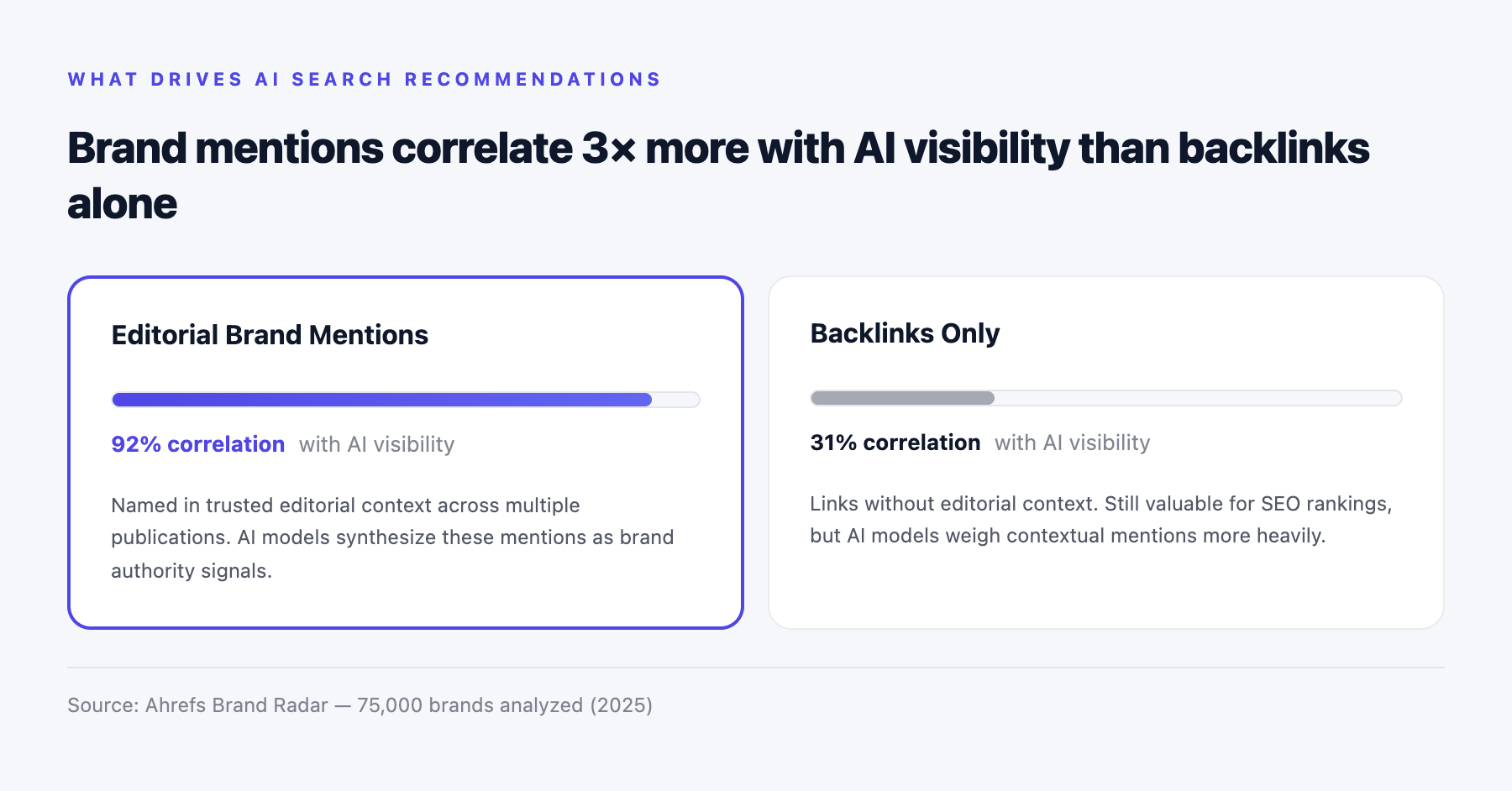
Ahrefs studied 75,000 brands and found that brand mentions from editorial coverage correlate 3x more strongly with AI visibility than backlinks alone. That's a massive shift. Traditional SEO rewarded link building. AI search rewards being talked about — by name, in context, by credible sources. Tech PR is one of the only channels that builds this signal at scale. For the full breakdown, see our guide to generative engine optimization.
The market is absurdly crowded
Every product category in tech has 15–50 competitors. Most of them look identical on a features page. PR is one of the few channels that creates differentiation through narrative rather than feature comparison. When a journalist at TechCrunch covers your approach to a problem — not your feature list, but your approach — that editorial positioning is nearly impossible for competitors to replicate.
Editorial backlinks are the hardest links to earn (and the most valuable)
The link building landscape has consolidated around a few approaches that actually move rankings: digital PR, editorial placements, and original research. Guest posts and directories don't carry the authority they used to. A single editorial mention in Forbes, VentureBeat, or a top-tier trade publication earns a DR 70–90+ backlink that would cost $2,000–$10,000+ to acquire any other way. Tech PR generates these links as a byproduct of doing its actual job — earning coverage. See our digital PR and link building guide for how this works mechanically.
The Two Models of Tech PR
Here's where most guides gloss over the most important distinction in the entire industry. There are two fundamentally different models for tech PR, and choosing the wrong one is the #1 reason tech companies feel like "PR doesn't work."
Model 1: Traditional retainer PR
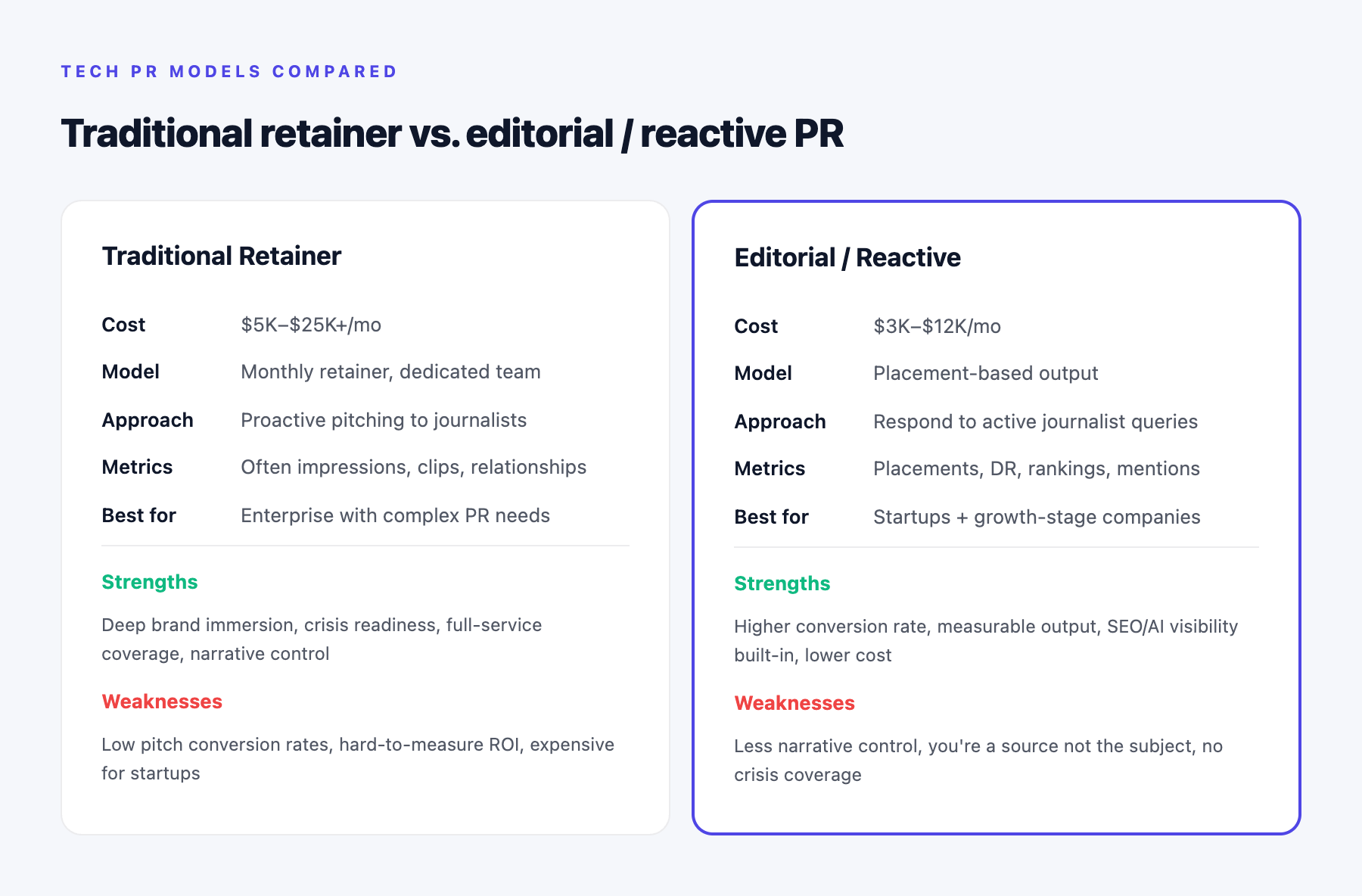
This is the model most people think of. You hire a PR agency on a monthly retainer ($5,000–$25,000+/month), and they provide a dedicated account team that handles media relations, drafts press releases, pitches journalists, manages your social presence, and coordinates launches.
The strengths are real: deep brand immersion, proactive strategy, crisis preparedness, and a team that knows your company inside and out. For enterprise tech companies with complex stakeholder landscapes, regulatory concerns, and frequent product launches, a good retainer agency is genuinely valuable.
The problems are also real. Many retainer agencies report on "relationships built" and "pitches sent" rather than placements earned. The monthly deliverable is often a call, a coverage report showing 2–3 clips, and a plan for next month. For a startup spending $10K/month, that math doesn't work. And because traditional agencies depend on proactive pitching — convincing journalists to write stories the journalist didn't plan to write — the hit rate on cold pitches to top-tier tech publications is notoriously low. We're talking single digits.
Model 2: Editorial / reactive PR
This is newer and less well-known. Instead of proactively pitching story ideas to journalists, reactive PR monitors what journalists are already working on — through platforms like Qwoted, Featured, Source of Sources, and direct journalist queries — and positions your executives as expert sources for stories that are already being written.
The difference matters. When a journalist at Bloomberg is writing about AI governance trends and needs a CTO to quote, your response to that query has a dramatically higher conversion rate than a cold pitch asking the same journalist to write about your company. You're filling a need they already have.
Reactive PR agencies typically charge based on placement output rather than (or in addition to) time-based retainers. The tradeoff: you don't control the narrative as tightly. You're a source in someone else's story, not the subject of a story written about you. But each placement still earns a high-authority backlink and brand mention from a publication your audience trusts — which is often what matters most for SEO and AI visibility.
Most tech companies benefit from starting with editorial/reactive PR to build a foundation of coverage and domain authority, then layering in traditional PR capabilities as they scale. Startups burning $15K/month on a retainer agency before they have product-market fit are spending money they can't measure. Start with placements you can count.
How to Choose a Tech PR Agency
Choosing a PR agency is one of those decisions that's easy to get wrong and expensive to fix. Here's what actually matters — and what doesn't.

What matters
Tech-specific journalist relationships. Ask the agency which journalists and publications they've placed clients in during the last 90 days. Not which journalists they "have relationships with" — which ones have actually published stories featuring their clients. If they can't name specific reporters at publications in your space, they're pitching blind.
Placement-level case studies. You want to see actual coverage URLs from tech clients in a similar category. Not "we helped a SaaS company build brand awareness" — show me the TechCrunch article, the VentureBeat mention, the industry trade placement. Agencies that deliver results are happy to show them. Agencies that don't deliver results talk about "strategic counsel" and "media ecosystem mapping."
Clear metrics tied to business outcomes. Coverage volume, average domain rating of placements, keyword ranking impact, brand mention growth, and referral traffic from coverage. Any agency still reporting primarily on "impressions" or "potential reach" is using vanity metrics because they can't show real ones.
Crisis capabilities (for enterprise). If you're an established tech company, your agency needs crisis experience. Ask for specific examples of crises they've managed — security incidents, product failures, executive issues. The answer should be detailed and specific, not "we have a crisis framework."
Red flags
Guaranteed placements in specific publications. No honest agency can guarantee a journalist will publish a story. They can guarantee effort, process, and a track record — but guaranteeing "we'll get you in Forbes" is either a lie or means they're paying for a contributed post (which is not earned media).
No tech clients in the portfolio. Tech PR requires understanding product categories, development cycles, and technical terminology. An agency whose portfolio is restaurants and real estate developers won't have the journalist relationships or subject matter depth to represent a tech company effectively.
Vague deliverables. If the proposal says "strategic media counsel, relationship development, and ongoing outreach" without specifying expected placement volume, cadence, or target publications — that's a retainer designed to be hard to evaluate. Good agencies define what success looks like in writing.
Press-release-only agencies. Some agencies are essentially wire distribution services with a PR label. They write announcements, push them through a distribution service, and count the syndication pickups as "coverage." Those pickups carry almost zero SEO or credibility value. Real tech PR earns original editorial coverage where a journalist decided your story was worth writing.
Reporter Outreach operates the editorial/reactive model. We monitor journalist platforms daily and pitch your executives as expert sources for stories already being written — across technology, SaaS, cybersecurity, and healthtech. Services start at $3,000/mo for 7 editorial placements (DR 75+ average). See our agency comparison for how we stack up.
Tech PR for Startups vs. Enterprise
The PR playbook for a Series A startup and a publicly traded enterprise company have almost nothing in common. Here's what actually works at each stage.
Startups (pre-Series B)
You probably don't need a $15K/month retainer agency. What you need is coverage that builds domain authority and brand recognition with the smallest possible budget.
The most effective startup PR strategy: leverage your founder's expertise. Founders at early-stage companies have something PR agencies can't manufacture — genuine, hands-on technical knowledge and strong opinions about where the industry is headed. A founder who can speak credibly about AI infrastructure, cybersecurity frameworks, or developer tooling is exactly what journalists need when they're writing trend pieces.
Pair that with reactive media outreach. Respond to journalist queries on platforms like Qwoted and Featured. Each placement earns a high-authority backlink, a brand mention, and a credibility signal. Do this consistently for six months and you'll have a coverage portfolio that makes investors, customers, and future hires take you seriously.
What startups should skip: expensive launch campaigns before you have product-market fit, social media management agencies (your founder's authentic LinkedIn presence outperforms any managed account), and PR agencies that want 12-month commitments before delivering a single placement.
Enterprise (Series C+ / public)
At this stage, PR serves different goals: reputation protection, executive positioning across multiple spokespeople, analyst relations, crisis preparedness, and coordinated multichannel campaigns around major launches.
Enterprise tech companies typically need a full-service agency or an in-house team supplemented by specialist agencies. The combination looks like: a retainer agency handling day-to-day media relations, crisis planning, and executive communications — plus a reactive/editorial agency driving consistent placement volume for SEO and AI visibility. The retainer agency protects your reputation. The editorial agency builds your authority.
The biggest PR mistake enterprise companies make? Assuming their name alone generates coverage. As new competitors enter the market, maintaining thought leadership requires active effort. The CTO who was regularly quoted in 2023 is invisible in 2026 if the PR team stopped pitching in 2024.
B2B vs. consumer tech
One more distinction that matters. B2B tech PR targets trade publications (TechCrunch, VentureBeat, industry-specific trades), LinkedIn, analyst briefings, and speaking slots at industry events. Consumer tech PR targets mainstream media, social platforms (Instagram, TikTok, YouTube), influencer partnerships, and review sites. The journalist relationships, platforms, and success metrics are completely different — which is why an agency's portfolio needs to match your category, not just "tech."
What Tech PR Actually Delivers: Case Study
Theory is useful. Numbers are better. Here's what a sustained editorial PR campaign delivered for a tech company. (See all case studies.)
Mistakes Tech Companies Make With PR
After working with 500+ tech companies on editorial campaigns since 2017, we see the same mistakes repeatedly. Avoid these and you're already ahead of most competitors.
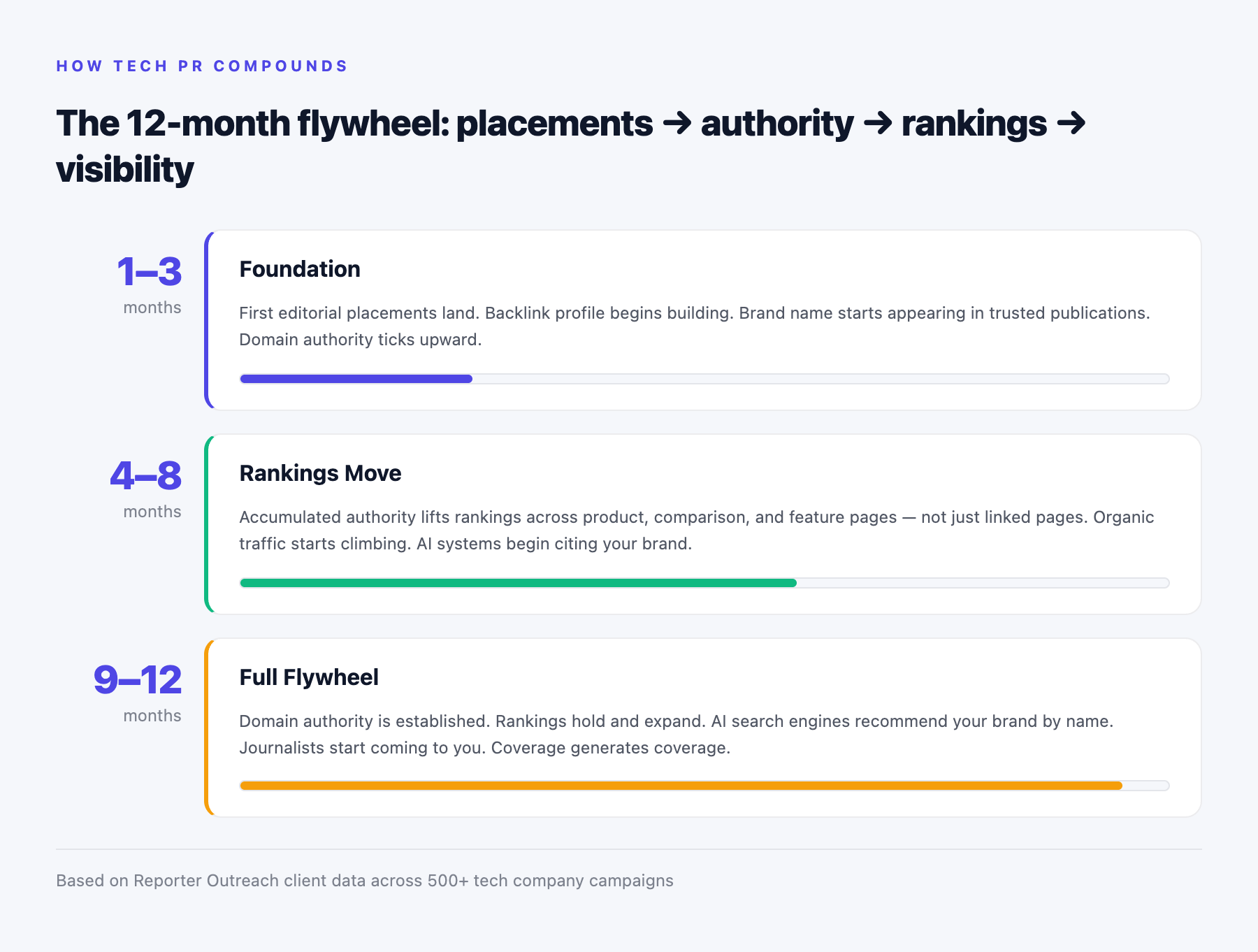
Treating PR as a one-time push. Companies launch, hire a PR agency for three months, get a handful of placements, then stop. PR compounds over time — the first three months build the foundation, months four through eight are where rankings start moving, and months nine through twelve are where you see the full SEO and AI visibility impact. Stopping at month three is like planting seeds and pulling them up before they sprout.
Confusing press releases with PR. A press release on a wire service is an announcement tool, not a media strategy. Wire syndication generates near-zero editorial value. The sites that "pick up" your press release are automated syndication feeds, not journalists who decided your story mattered. Real coverage requires a journalist to read your pitch, find it interesting, and write something original.
Ignoring SEO entirely. Most traditional PR agencies don't track backlink metrics, domain rating, or keyword ranking impact. They report on clips and impressions. That means you're missing the most measurable, compounding value of PR — the editorial backlinks that build domain authority and the brand mentions that drive AI visibility. If your PR agency can't tell you the average DR of your placements, they're leaving value on the table.
Waiting for a crisis to think about crisis comms. Especially relevant for companies handling sensitive data — fintech, healthtech, cybersecurity, edtech. The time to build a crisis communications plan is when nothing is on fire. Draft holding statements, designate spokespeople, establish escalation procedures, and media-train your executives before you need any of it.
Hiring generalists for a specialized job. A PR agency that represents restaurants, consumer goods, and "also some tech companies" doesn't have the journalist relationships, subject matter expertise, or category credibility to represent a technology company effectively. The journalist covering enterprise AI at The Information doesn't want to hear from an agency whose other clients are a juice brand and a personal injury firm.
Ready to Build Real Coverage?
We earn editorial placements in the publications your audience actually reads — building the backlinks, brand mentions, and authority signals that drive SEO and AI visibility.
FAQ
What is tech PR?
Tech PR is public relations for technology companies. It includes media relations, crisis communications, thought leadership, product launches, social media strategy, and analyst relations — all focused on building coverage, credibility, and visibility with the audiences that matter to tech brands.
How much does a tech PR agency cost?
Traditional full-service tech PR retainers range from $5,000–$25,000+/month. Editorial PR agencies focused on measurable placement output (like Reporter Outreach) typically range from $3,000–$12,000/month. Startups should expect to invest at least $3,000/month for 6+ months to see compounding results.
Do tech startups need PR?
Startups arguably benefit more from PR than established companies because each placement represents a proportionally larger visibility increase. Founders with genuine technical expertise are ideal sources for journalists — making reactive media outreach especially effective for early-stage tech companies with limited budgets.
How does tech PR help with SEO?
Editorial PR placements earn backlinks from high-authority publications (DR 70–90+). These links build domain-wide authority that improves rankings across your entire site — not just the linked pages. PR also generates the editorial brand mentions that AI search engines use to determine which companies to recommend, making it one of the few channels that drives both traditional SEO and AI visibility from a single effort.
What's the difference between tech PR and general PR?
Tech PR requires specialized journalist relationships in the technology space, the ability to translate complex technical concepts into media-ready narratives, and understanding of product categories like SaaS, cybersecurity, AI, and enterprise software. General PR agencies lack these capabilities and the journalist contacts needed for effective tech coverage.
What's the difference between proactive and reactive PR?
Proactive PR means pitching story ideas to journalists — convincing them to write something they weren't already planning. Reactive PR means monitoring what journalists are actively working on and positioning your executives as expert sources for those existing stories. Reactive PR has a higher placement conversion rate because you're filling a need journalists already have.
Sources
- Ahrefs — Brand Radar AI Visibility Correlation: 75,000 Brands (2025)
- Editorial.link — State of Link Building 2024–2025
- Digitaloft — PR Success Study: 500 Campaigns
- BuzzStream — State of PR Report 2026
- Conductor — AI Overviews Prevalence Report (Q1 2026)