

Key Takeaways
- 64% of SEOs spend $3,000+ per month on backlinks; 38% spend $6,000+ and 17% spend $12,000+
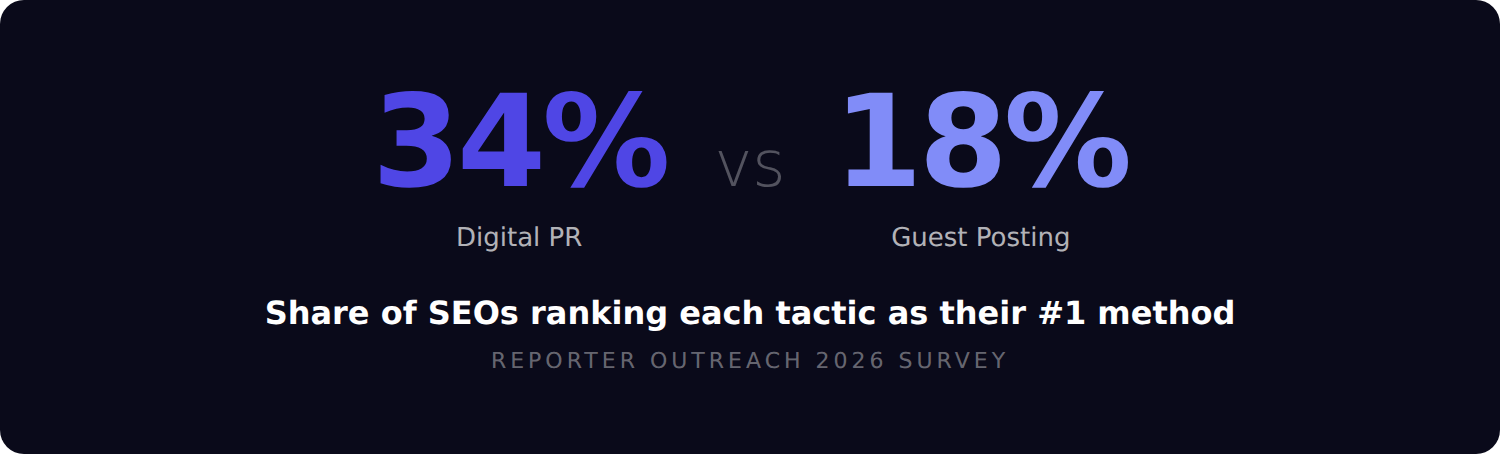
- Digital PR has overtaken guest posting as the top-performing tactic — 34% vs 18%, nearly 2x
- 91% of SEOs set a minimum DR before placing links; 52% require DR 50+
- 74% believe backlinks influence AI search visibility, but only 19% have changed their strategy
- #1-ranked pages have 3.8x more backlinks than positions 2–10, and 95% of web pages have zero backlinks at all
These backlink statistics come from the Reporter Outreach State of Link Building 2026 — a Q1 2026 survey of 500 SEO professionals — supplemented with data from Ahrefs, BuzzStream, Backlinko, Digitaloft, and Reboot Online. Every original stat is cited with its source so you can verify and reuse freely.
The through-line for 2026: budgets are up, quality thresholds are stricter, digital PR has become the dominant tactic, and most teams haven't adjusted for AI search yet. Everything below is citable — scroll or jump to a section.
Budget and Spend
Budgets climbed in 2026. Most respondents raised their spend year over year; only a small minority pulled back. The gap between agency and in-house allocation is narrower than most assume — in-house teams actually invest more heavily as a share of SEO budget.

| # | Statistic | Source |
|---|---|---|
| 1 | 64% of SEOs spend $3,000+ per month on backlinks. | Reporter Outreach, 2026 |
| 2 | 38% spend $6,000+ per month, with 17% spending $12,000+. | Reporter Outreach, 2026 |
| 3 | 58% increased their 2026 budget compared to 2025. | Reporter Outreach, 2026 |
| 4 | Only 14% decreased their budget year-over-year. | Reporter Outreach, 2026 |
| 5 | Agencies allocate 32.1% of total SEO budget to link acquisition; in-house teams allocate 36%. | Editorial.link, 2026 |
| 6 | Average minimum monthly budget to compete in highly competitive niches: $8,406. | Editorial.link, 2026 |
Cost and Pricing
Per-link pricing continues to rise. Most respondents expect that trend to hold, and publishers are already charging 20–40% more than they did two years ago.
| # | Statistic | Source |
|---|---|---|
| 7 | 76% of SEOs pay $300+ per link. 47% pay $500+. 16% pay $1,000+. | Reporter Outreach, 2026 |
| 8 | Average price SEOs are willing to pay for a single quality backlink: $508.95. | Editorial.link, 2026 |
| 9 | 75% expect costs to rise over the next 2–3 years. Only 8% expect them to decrease. | Reporter Outreach, 2026 |
| 10 | 80.9% of specialists believe it will become harder and more expensive over the next 2–3 years. | Editorial.link, 2026 |
| 11 | Publisher placement fees have increased 20–40% over the past two years. | RhinoRank, 2026 |
| 12 | Average cost per earned digital PR link: approximately $750. | BuzzStream, 2026 |
Methods That Actually Work
Digital PR has pulled ahead of every other tactic. Link exchanges tell the opposite story — heavy usage, zero top-performer votes. That's the widest effectiveness gap in the data.
| # | Statistic | Source |
|---|---|---|
| 13 | 34% rank digital PR as their #1 best-performing method — nearly 2x guest posting (18%). | Reporter Outreach, 2026 |
| 14 | 55% say PR-style approaches (digital PR + journalist sourcing) deliver their best results overall. | Reporter Outreach, 2026 |
| 15 | 85.8% of digital PR practitioners cite backlinks as the primary benefit of their work. | BuzzStream, 2026 |
| 16 | The average digital PR campaign earns links from 42 unique referring domains at an average DR of 61. | Digitaloft / Reboot Online |
| 17 | 45.6% use digital PR. 44% use broken link building. 43.8% use link exchanges. 42.4% use guest posting. | Reporter Outreach, 2026 |
| 18 | 43.8% use link exchanges, but 0% ranked them as their best method — the widest usage-to-effectiveness gap in the data. | Reporter Outreach, 2026 |
| 19 | 85.2% of digital PR campaigns show measurable SEO results within 3–6 months. | BuzzStream, 2026 |
| 20 | Only 8.5% of cold outreach emails result in a backlink. | Backlinko |
| 21 | Long-form content (3,000+ words) generates 3.5x more backlinks than shorter content. | Backlinko |
Link Quality Standards
Quality thresholds are now near-universal. Only 9% of respondents skip a minimum DR entirely, meaning the vast majority have moved past a pure-volume approach.
| # | Statistic | Source |
|---|---|---|
| 22 | 62% prioritize link quality over quantity. Only 9% still chase volume. | Reporter Outreach, 2026 |
| 23 | 52% require a minimum domain rating of DR 50+ for any placement. 22% require DR 60+. | Reporter Outreach, 2026 |
| 24 | Only 9% set no minimum DR — meaning 91% have quality thresholds. | Reporter Outreach, 2026 |
| 25 | Pages ranking #1 on Google have 3.8x more backlinks than pages in positions 2–10. | Backlinko |
| 26 | 95% of all web pages on the internet have zero backlinks. | Ahrefs |
| 27 | Only 2.2% of content successfully earns external backlinks. | Ahrefs |
| 28 | 73.6% of websites have some reciprocal links — most are natural. Deliberate exchange schemes are the risk. | Ahrefs |
| 29 | 53% of Google penalties are caused by sponsored/paid links with keyword-rich anchor text. | Semrush |
Backlinks and AI Search
Awareness is high; action is rare. Three-quarters of SEOs believe backlinks influence AI visibility, but only 19% have made any strategic changes. The gap between "this matters" and "we changed something" is where the opportunity lives.
| # | Statistic | Source |
|---|---|---|
| 30 | 74% believe backlinks impact AI search visibility (46% somewhat, 28% significantly). | Reporter Outreach, 2026 |
| 31 | Only 24% actively track their AI search visibility. 25% are planning to. 51% aren't tracking at all. | Reporter Outreach, 2026 |
| 32 | Only 19% have adjusted strategy for AI search. 34% are planning to. 47% haven't changed anything. | Reporter Outreach, 2026 |
| 33 | Brand mentions correlate 3x more strongly with AI visibility (0.664) than backlinks alone (0.218). | Ahrefs, 2025 |
| 34 | 66.2% of digital PR practitioners now track AI citations as a KPI — a metric that didn't exist in 2025 surveys. | BuzzStream, 2026 |
| 35 | Google AI Overviews now reaches 1.5 billion monthly users across 200+ countries. | Google, 2025 |
| 36 | 73.2% believe backlinks influence whether a brand appears in AI Search Overviews. | Editorial.link, 2026 |
Who's Building Links
A quick profile of the 500 SEOs surveyed. Two-thirds have 3+ years of experience, and the sample skews toward agencies and SaaS.
| # | Statistic | Source |
|---|---|---|
| 37 | 38% of respondents work at agencies. 22% in SaaS. 14% in eCommerce. 9% in healthcare. 7% in finance. 5% in legal. | Reporter Outreach, 2026 |
| 38 | 66% have 3+ years of experience. 35% have 5+ years. | Reporter Outreach, 2026 |
| 39 | 32% are agency owners. 27% SEO specialists. 21% in-house marketers. 15% freelancers. | Reporter Outreach, 2026 |
| 40 | 52.3% of digital marketers consider link acquisition the most challenging aspect of SEO. | Authority Hacker |
| 41 | 91.89% of respondents believe their competitors buy links. | Editorial.link, 2026 |
| 42 | Marketers spend 28% of their budget on acquiring quality backlinks. | DemandSage, 2026 |
How Backlinks Affect Rankings
The data on rankings is consistent: referring domain count is the strongest correlation, content type matters, and most pages on the internet aren't in the game at all.
| # | Statistic | Source |
|---|---|---|
| 43 | The number of referring domains correlates more strongly with Google rankings than any other backlink metric. | Backlinko |
| 44 | Websites with 30–35 high-quality backlinks generate over 10,500 visits per month on average. | uSERP / DemandSage |
| 45 | Google uses 200+ ranking factors, with backlinks among the most important. | Backlinko |
| 46 | The top 3 ranking factors for Google are high-quality content, page experience, and links. | Search Engine Journal |
| 47 | Sites that publish blog content regularly receive 97% more links from external sites. | HubSpot |
| 48 | 94% of online content earns zero external links. | Ahrefs |
| 49 | Original research and statistics pages attract 200% more links on average than other content formats. | PressWhizz, 2026 |
| 50 | Backlinks account for approximately 14% of total SEO ranking power. | FirstPageSage |
Real Campaign Results
Data from live digital PR campaigns managed by Reporter Outreach — real numbers from real clients across industries.
| # | Statistic | Source |
|---|---|---|
| 51 | A SaaS client saw a 2,203% organic traffic increase in 6 months from editorial links averaging DR 78. | Reporter Outreach |
| 52 | An eCommerce client achieved a 555% organic traffic increase in 10 months with links averaging DR 79. | Reporter Outreach |
| 53 | A healthcare client saw a 352% organic traffic increase in 9 months — 39 placements and mentions averaging DR 80. | Reporter Outreach |
| 54 | An online telehealth platform achieved a 124% organic traffic increase in 12 months with 83 placements and mentions averaging DR 81. | Reporter Outreach |
Original stats (marked "Reporter Outreach, 2026") come from a Q1 2026 survey of 500 SEO professionals. Respondents: agency owners (32%), SEO specialists (27%), in-house marketers (21%), freelancers (15%) across SaaS, eCommerce, healthcare, finance, and legal. 66% have 3+ years of experience. Third-party stats are cited with their original source. For the full narrative analysis, see the State of Link Building 2026 report.
Backlink Statistics FAQ
Are backlinks still an important ranking factor in 2026?
Yes. Search Engine Journal puts links in the top three Google ranking factors, and 74% of surveyed SEOs believe backlinks influence AI search visibility too. The methods have shifted — digital PR has overtaken guest posting — but the value of quality backlinks hasn't diminished. 58% of teams increased their 2026 budget, which tells you where the industry consensus sits.
Is guest posting still effective?
Still widely used — 42.4% of respondents use it — but it's no longer the top performer. Only 18% rank guest posting as their best method vs 34% for digital PR. Publishers have raised fees faster than results have scaled, which is squeezing ROI. Guest posting works as one piece of a diversified approach, not as the centerpiece.
What is broken link building?
You find a dead page that other sites link to, then reach out suggesting your content as the replacement. 44% of SEOs use it. The appeal: you're solving a problem for the site owner rather than asking for a favor, which raises conversion relative to cold pitches.
Does content marketing actually earn backlinks?
If the content earns them — yes. Regular publishers receive 97% more external links per HubSpot, and long-form content pulls 3.5x more backlinks. Original research and data studies are the strongest format: 200% more links on average vs typical formats. Most content earns zero links; the top few percent earn most of them.
What counts as white hat link building?
Earning links through editorial placements, original research, digital PR, resource pages, and genuine outreach — anything Google would endorse on the record. Not PBNs, not cloaked redirects, not link farms. 62% of SEOs now prioritize quality over quantity, which is the white hat shift codified in data.
What makes a link "quality"?
Domain Rating is the dominant filter — 52% require DR 50+, 22% require DR 60+. Beyond DR, SEOs evaluate organic traffic to the linking page, topical relevance, and whether the placement is editorial (a writer chose to cite you) vs paid. An editorial link from a DR 70 publication is the gold standard.
Do nofollow links count?
Not directly for link equity — Google treats nofollow as a hint — but they carry real value. Nofollow links from major publications build brand visibility, drive referral traffic, and contribute to the brand signals that correlate with AI citations. A natural profile mixes both; chasing only dofollow creates a pattern that looks engineered.
How do unlinked brand mentions help?
They're an implicit endorsement Google can weight even without a hyperlink. They're also the highest-converting outreach opportunity you have: asking a journalist to add a link to an existing mention succeeds far more often than cold pitching. Ahrefs and Google Search Console both surface them.
Why do 95% of web pages have zero backlinks?
Most content isn't built to earn links — it's built for keyword targeting, navigation, or internal purposes. Add to that the fact that 94% of content earns zero external references (Ahrefs) and you see why a deliberate acquisition strategy matters. The top pages aren't lucky; they're the small percentage that was designed to get cited.
Do internal links matter?
They don't replace external backlinks, but they route authority around your site and help Google discover new content. A strong internal linking structure also helps newer pages rank faster. Fix broken internal links first — it's the cheapest win in any SEO audit.
Should I hire an agency or build links in-house?
Depends on speed, scale, and publisher access. In-house teams allocate 36% of their SEO budget to link acquisition — it's not cheaper, it just buys different things. Agencies bring existing publisher relationships and digital PR capacity that takes years to build internally. Many teams run a hybrid: in-house for content and internal links, outsourced for digital PR. Our SEO outsourcing framework walks through the split.
Are reciprocal links risky?
Natural reciprocal links are fine — 73.6% of sites have some, and Google knows this. The risk is in engineered exchange schemes at scale, especially with keyword-rich anchor text. 43.8% of respondents use link exchanges and 0% call them a top-performing method. The effort-to-return ratio isn't in your favor.
How does domain authority factor in?
Domain authority metrics (Ahrefs DR, Moz DA) are proxies for trust earned through backlinks. Higher DR = more equity passed when that site links to you. For acquisition decisions, it's the first filter: 52% of respondents won't place a link on a site below DR 50. Higher DR also compresses the timeline to rank competitive terms.
What are the biggest challenges in 2026?
Cost pressure, quality scarcity, and AI adaptation. 52.3% of digital marketers already called acquisition the hardest part of SEO; 75% expect costs to keep rising; and most teams haven't adjusted their strategy for AI search even though they believe AI visibility matters. The gap between belief and action is the defining issue this year.
Related Guides
- State of Link Building 2026 — full narrative analysis and methodology
- Link Building Pricing: What It Costs in 2026
- Digital PR Link Building: The Complete Guide
- How Many Backlinks Do I Need to Rank?
- What Is a Backlink Profile?
- White Hat Link Building: Safe Strategies for 2026
Want these numbers working for you?
We build high-authority editorial links that move rankings. Book a free strategy call to see what a campaign could do for your site.
Book a Strategy Call →Sources
- Reporter Outreach — State of Link Building 2026 (500 SEO professionals surveyed)
- Editorial.link — State of Link Building 2024 (518 SEO professionals surveyed)
- BuzzStream — State of Digital PR Report 2026
- Ahrefs — Content Explorer & Brand Radar AI Visibility Study (2025)
- Backlinko — Search Engine Ranking Factors Study
- Digitaloft / Reboot Online — Digital PR Campaign Analysis
- Authority Hacker — Link Building Survey
- Semrush — Backlink Penalty Analysis (830+ profiles)
- DemandSage — Link Building Statistics Compilation
- RhinoRank — Publisher Pricing Trends Report
- FirstPageSage — SEO Ranking Factors Analysis
- PressWhizz — Link Building Statistics 2026
- Google — AI Overviews Expansion Announcement (2025)
- Search Engine Journal — Top Google Ranking Factors